Understanding identity beyond the illusion of singular belonging
Why do we demand that individuals be only one thing when the very malleability of the mind is the defining feature of our human condition?
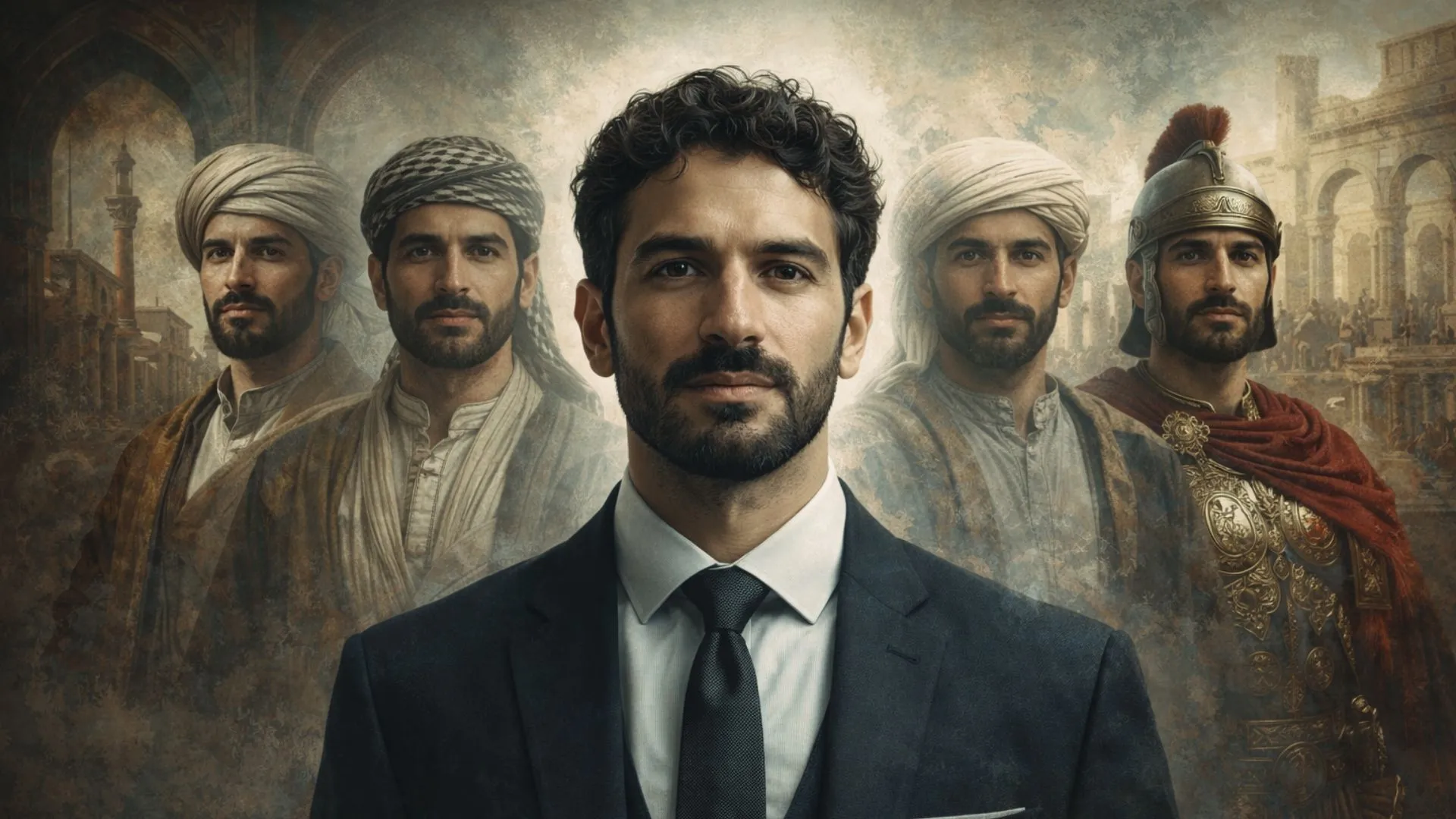
There is a man. Born in Syria, his native language is Arabic. He is Christian. Today, he lives in Germany. Let us say he holds dual nationality. He works, pays taxes, and raises his children in a German city, all while keeping a vivid memory of Damascus, its meals, its prayers, its accents, and its absences. He navigates between two collective imaginaries, two narratives, two ways of saying “we.”
However, the question that recurs, sometimes with brutal directness, at other times with a politeness that softens nothing, is almost always the same: what is he, deep down?
Syrian? German? Arab? Christian?
The question appears simple. It is even frequently asked as if it demanded a simple, unique, definitive answer, as if identity were a label to be attached once and for all. It is posed as though the moment the “correct” box is checked, everything suddenly becomes coherent.
On the other hand, the question is poorly framed.
It assumes that identity operates through exclusion, meaning that being one thing prevents someone from being another. It also assumes the existence of a “true” belonging, one deeper than the rest, which must ultimately prevail. Most importantly, it reveals a reflex, which is our compelling need to stabilize, to confine a person within a legible form, to reduce complexity to unity.
Perhaps this is precisely where the real tension resides. It is not identity that is unstable. It is our need to stabilize it that creates anxiety.
In a world where life trajectories overlap, encompassing multiple languages, nationalities, memories, religions, and cultures, we continue to rely on conceptual frameworks inherited from a more homogeneous era. We demand continuous narratives, clear allegiances, and distinct symbolic boundaries. When human reality overflows these boundaries, we label it a crisis, confusion, or a loss of reference points. This happens perhaps because we mistake complexity for disorder.
This article does not aim to resolve the question of identity, nor does it intend to offer a recipe for peaceful societies, as that would betray the depth of the subject. Instead, it seeks to explore a fragile intersection, the exact contact point between historical consciousness, the way a collective narrates itself, and identity, the way an individual stands upright amidst multiple belongings. This is often where everything is decided, when collective narratives strive for absolute consistency while individual existence refuses to be unequivocal.
Returning to this man, the true question is perhaps not to discover what he is. The true question is to understand why we feel such an intense need for him to be only one thing.
🔗 Read also: The stolen identity
Identity: a configuration, not an essence
Amin Maalouf, in In the Name of Identity: Violence and the Need to Belong, insists on a point that disrupts simple classifications: we do not possess a single belonging, but rather a combination of multiple belongings. Each one matters, but none can summarize the whole. Religion, language, nationality, family history, lived experiences, all of these construct an inner architecture. To reduce an individual to just one of these dimensions is to symbolically amputate them.
Maalouf speaks of a shifting hierarchy of belongings. Depending on the context, one aspect can become more visible, more prominent, or more defensive. It is not that the essence of identity changes. Rather, the environment shifts the center of gravity. In a situation of religious conflict, religion may become dominant. Within an administrative framework, nationality prevails. In the intimacy of home, family memory might take over. Identity is not a static substance; it is a dynamic configuration.
This perspective closely mirrors the philosophical concepts of Paul Ricoeur. For him, identity is not a fixed asset possessed once and for all. It is a narrative identity. We understand ourselves through the story we construct about ourselves. Ricoeur distinguishes between sameness (mêmeté), what appears stable and repetitive, and selfhood (ipséité), the capacity to maintain oneself through change. In other words, we remain ourselves not because nothing changes, but because we succeed in weaving these changes into an interpreted continuity.
This sheds light on the condition of any individual caught between multiple allegiances. Their identity cannot be reduced to a fixed point. It is a trajectory. It connects languages learned at different stages of life, childhood landscapes with cities of adoption, and inherited beliefs with novel experiences. The individual composes a coherent story, or at least one coherent enough to hold together. This internal labor is permanent. It is not a one-time choice, but an ongoing adjustment.
If we follow this line of thought, plurality is not a modern anomaly. It is constitutive of the human experience. Even in more homogeneous societies, individuals have always belonged to multiple circles, including family, region, profession, religion, and social class. What has changed today is the visibility and intensity of these overlaps. Geographical borders are crossed more easily. National narratives no longer coincide perfectly with individual trajectories.
Nevertheless, despite this obvious complexity, we persist in asking the question as if one identity had to override all others, as if equilibrium were suspicious, as if multiplicity threatened internal unity. Perhaps we still unconsciously associate stability with purity, and coherence with simplicity.
Still, neither Maalouf nor Ricoeur suggests that multiplicity condemns the individual to fragmentation. On the contrary, identity can remain stable without being uniform. It can be coherent without being homogeneous. It can evolve without dissolving.
The difficulty, therefore, does not lie in plurality itself. It arises when we demand that an identity be univoque, when we assume that an individual should be summarized in a single line.
It is at this precise juncture that the reflection shifts to another level, that of collective narratives. While an individual can endure complexity, provided they find a sense of continuity within it, what happens to nations? How does a political community, which requires a minimum of symbolic cohesion, integrate this growing plurality without seeking to simplify it?
This is where historical consciousness enters the scene.
🔗 Explore further: Subjective age: When the mirror and the mind disagree
Historical consciousness and the need for coherence
History, as an academic discipline, accepts complexity. It cross-references sources, highlights contradictions, and revisits its own certainties. However, the historical consciousness of a nation obeys different demands. It does not merely seek the factual truth of the past. It seeks a liveable continuity. It must produce a narrative stable enough for those who live within it to recognize themselves.
Benedict Anderson described the nation as an “imagined community.” This is not because it is fictitious, but because it relies on a shared representation. Individuals who do not know each other personally believe they are bound by a common history. This representation requires a process of selection. Certain events become foundational. Others fade into the background. Every collective memory organizes the past to make the present intelligible.
This mechanism appears with particular clarity when we observe how certain historical periods are heavily invested with symbolic meaning. Medieval Andalusia, for instance, is not merely an object of study for historians. It has become a symbol, viewed differently depending on the era and the perspective. For some, it embodies a memory of coexistence and cultural refinement. For others, it represents a parenthesis to be closed in pursuit of an older continuity. For others still, it remains just one fragment among many in the long history of the Iberian Peninsula. The past itself does not alter, but the narrative to which we cling shapes the way we position ourselves in the present. Historical consciousness does not merely preserve; it orientates.
This phenomenon does not belong exclusively to distant centuries. It moves through the European present. Following the independence of former colonies, workers from the Maghreb, South Asia, or Sub-Saharan Africa settled permanently in France, the United Kingdom, and Germany. Their children were born on European soil. They speak the national language, attend the same schools, and share the same public spaces. Nevertheless, they also inherit another memory, transmitted through family, domestic language, and ancestral stories.
The question that arises is not primarily legal. It is narrative. The national narrative, as it was constructed in the nineteenth and twentieth centuries, often presupposed a relatively homogeneous continuity. When new trajectories engrave themselves permanently into the social landscape, historical consciousness must adjust. It can expand its narrative, acknowledge new layers, and integrate multiple memories. It can also hesitate, retreat, or attempt to preserve a narrower line.
In both cases, this is not just a matter of ideology. It is a matter of cohesion. As Ibn Khaldûn anticipated with his concept of asabiyya, any political community requires a principle of solidarity to endure. The modern nation has shifted this principle toward a shared memory. However, this memory is never frozen. It is constantly reinterpreted, sometimes silently, as successive generations take their place.
Historical consciousness thus walks a delicate line. It cannot become pure indeterminacy without losing its cohesive function, but it cannot indefinitely ignore the actual transformations of human trajectories. It stabilizes to exist; it adjusts to survive.
It is within this space, between stabilization and adjustment, that the tension with individual identities, now more visible in their plurality, emerges.
🔗 Discover more: Living with our digital doubles
Transnational belongings
The modern nation is not the sole framework of belonging. It never has been. Before the emergence of territorial nation-states, other forms of community structured collective identities, whether religious, imperial, or cultural. Some of these forms have not vanished; they have layered themselves on top of national frameworks.
The concept of the Ummah in the Islamic tradition is an illuminating example. It designates the community of believers, a belonging that transcends political borders and territorial divisions. It does not rely on nationality, but on a shared spiritual reference. An individual can belong to a specific state while recognizing themselves as a member of a much larger, transnational community.
Ibn Khaldûn himself observed that religion could reinforce the cohesion of a group by giving it a dimension that exceeds purely tribal solidarities. Later, in the modern era, reformist thinkers such as Muhammad Abduh and Rashid Rida had to confront a new tension: how to articulate the idea of a universal religious community with the emergence of nation-states, their borders, and their citizenships? The Ummah does not naturally coincide with the nation. It traverses it.
This point is by no means anecdotal. It reveals that the plurality of belongings does not date from contemporary globalization. It is inscribed in the history of political and religious ideas. An individual can be a citizen of a country, a member of a spiritual community that exceeds it, a speaker of a transnational language, and the heir to a local memory. These belongings do not necessarily cancel each other out. They add up, sometimes ignore one another, and sometimes enter into tension.
At this stage, the reflection can no longer remain solely theoretical, because these superpositions are not abstract. They are inscribed within the psychic life of individuals.
This is where fragility appears.
On the other hand, so does possibility.
🔗 Read also: The limits of science and the depths of the human psyche
Psychic malleability and its inner fragilities
The superpositions of belongings do not remain outside the individual. They engrave themselves within. They structure the individual’s relationship to the world, to others, and to themselves. A composite identity is not just a social fact; it becomes an inner experience.
In certain cases, this plurality produces a genuine psychic malleability. The individual learns to navigate between multiple codes, multiple narratives, and multiple symbolic registers. They develop a capacity for adaptation, a critical distance, and sometimes even a form of inner freedom. Not being entirely contained within a single definition can offer a breathing space. Plurality then becomes a resource.
However, this very plurality can also weaken. When no framework fully recognizes the lived complexity, the individual can experience a permanent sense of being in-between, too much of a foreigner here, not legitimate enough there. The repeated question, “where are you really from?” eventually cracks the narrative of the self. If, as Paul Ricoeur suggests, identity relies on narrative continuity, that continuity must still be tellable without being constantly challenged.
The philosopher Charles Taylor showed how crucial recognition is to the modern identity. We do not construct ourselves in isolation. We require a gaze that confirms our place. Unrecognized plurality can turn into an internal tension. This is not because it is inherently incoherent, but because it fails to find a stable symbolic space.
This is where fragility appears, not within diversity itself, but in the disconnect between the lived complexity and the categories available to articulate it. Plurality is an opportunity when it is inhabited and recognized. It becomes unstable when it is summoned to simplify itself.
The person who carries multiple belongings is neither condemned to fragmentation nor guaranteed inner harmony. They hold themselves in an equilibrium. Like any equilibrium, this one demands constant adjustments.
Perhaps the question is not to know what they are.
Perhaps the question is to know whether we accept that they can be several things at once, and remain so.
It is not their identity that is unstable.
It is our need for it to be stable.
🔗 Read also: Who am i online? Rethinking identity in the social media era
The human scale of the ever-evolving narrative
Our man does not live out a book. He simply moves forward at the junction of several narratives. One language carries him, another surrounds him. Childhood memories persist while a different present is being built. He belongs, without ever closing himself off.
There is nothing exceptional in this. Nevertheless, it demands constant attention to connect, to adjust, to translate. It requires inhabiting the movement without losing the thread.
This configuration is by no means definitive. Belongings can shift. Some can become more central, while others fade. An encounter, a decision, a rupture, a choice, and the inner architecture reorganizes itself.
What if, tomorrow, this man were to change his faith?
What if he decided to move to Canada, or to Russia, or anywhere else?
Would we have to say that he is no longer the same?
Or that he remains himself, only differently composed?
That would not mean becoming a different man. It would mean pursuing the same story, written differently.
References
Abduh, M. (1966). Risālat al-tawḥīd [The theology of unity]. Dar al-Ma’arif. (Original work published 1897).
Anderson, B. (2006). Imagined communities: Reflections on the origin and spread of nationalism (Rev. ed.). Verso. (Original work published 1983)
Ibn Khaldûn. (1967). The Muqaddimah: An introduction to history (F. Rosenthal, Trans.). Princeton University Press. (Original work published 1377)
Maalouf, A. (1998). Les identités meurtrières. Grasset.
Ricoeur, P. (1990). Soi-même comme un autre. Seuil.
Rida, R. (1923). Al-Khilāfa aw al-imāma al-‘uzmā [The caliphate or the supreme imamate]. Al-Manar Press.
Taylor, C. (1994). The politics of recognition. In A. Gutmann (Ed.), Multiculturalism: Examining the politics of recognition (pp. 25–73). Princeton University Press.

Amine Lahhab
Television Director
Master’s Degree in Directing, École Supérieure de l’Audiovisuel (ESAV), University of Toulouse
Bachelor’s Degree in History, Hassan II University, Casablanca
DEUG in Philosophy, Hassan II University, Casablanca