1984: How language becomes a tool of power
Eliminating words to make certain ideas unthinkable, Newspeak turns language into a tool of cognitive control. How far can it shape reality?
In 1949, George Orwell published Nineteen Eighty Four.
A dark novel that went on to become one of the most influential dystopias of the twentieth century.
It is a world of total surveillance, political manipulation, propaganda, and control over both bodies and minds. Big Brother’s face is everywhere. Screens are watching. The past is rewritten. But at the heart of this oppressive world lies something more discreet, and perhaps even more radical.
Language.
In Orwell’s universe, power does not merely forbid. It reduces words. It simplifies nuance. It manufactures a new language, Newspeak, whose objective is clear: to make certain thoughts literally unthinkable.
Tyranny is only the backdrop. Orwell’s real laboratory lies elsewhere: in language, and in the way it structures thought.
🔗Read also: How the brain makes sense of Art
What happens when language loses nuance
“Every year, fewer and fewer words.”
With a kind of almost naïve enthusiasm, Syme, a zealous linguist working for the Party, explains the Newspeak project to Winston. His job is not to invent. It is to eliminate. To prune the dictionary. To cut out synonyms. To destroy nuance. Why keep “excellent,” “splendid,” or “magnificent” when “plusgood” is enough?
The goal is explicit: in time, certain thoughtcrimes will become impossible simply because there will be no words left to formulate them. “The Revolution will be complete when the language is perfect.” Behind this fiction lies a dizzying hypothesis: does our vocabulary really structure the way we think?
In linguistics, this idea has a name: the Sapir Whorf hypothesis. In its strong version, it claims that language determines thought, a position now widely disputed. But in its more moderate form, the one accepted by most researchers, language deeply influences the way we categorize the world.
Studies on color perception have become classics in the field. Populations whose languages distinguish a greater number of chromatic nuances are quicker to identify certain visual differences. The lexicon acts as a system of mental orientation. What we can name precisely, we can also discriminate more easily.
The same is true of emotions. Research in psychology shows that a rich emotional vocabulary supports better emotional regulation. Naming an experience precisely, frustration, disappointment, jealousy, melancholy, makes it easier to modulate one’s inner state. By contrast, a reduced register tends to flatten experience into broad categories: “I’m fine” or “I’m not fine.” Orwell pushes this mechanism to its limit. By removing intermediate words, Newspeak eliminates grey areas. Reality becomes binary. Good or ungood. Loyal or criminal.
Language does not create our thoughts ex nihilo. But it does trace the contours within which they take shape. The fewer distinctions are available, the fewer distinctions the mind can manipulate. In Orwell’s world, censorship operates through vocabulary. And to intervene in vocabulary is to intervene in mental categories themselves.
🔗Explore further: Beyond words: can we think without words?
Doublethink and the Psychology of Inner Contradiction
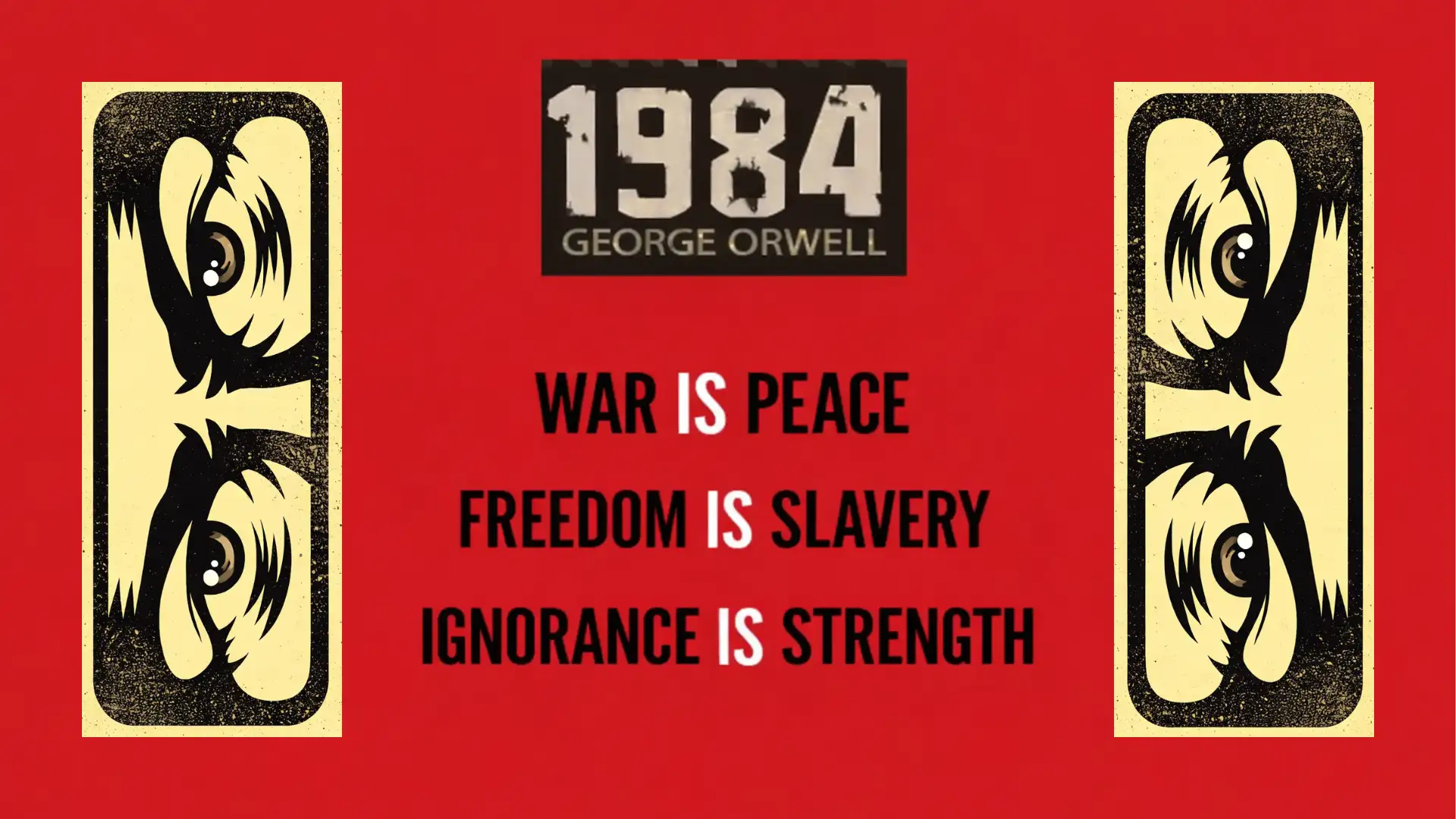
“War is peace. Freedom is slavery. Ignorance is strength.”
The Party’s slogans are not designed to persuade. They impose contradiction. And that contradiction is not a mistake. It is an exercise. In Nineteen Eighty Four, doublethink refers to the ability to accept two incompatible ideas at the same time, and to sincerely believe in both.
Winston gradually comes to understand that the Party’s ultimate power is not to forbid a thought. It is to make incoherence feel normal. To condition the mind to stop seeking consistency.
In psychology, this mechanism immediately recalls the theory of cognitive dissonance, formulated by Leon Festinger in 1957. When two incompatible beliefs coexist, the brain experiences internal tension. That tension is uncomfortable. To reduce it, we adjust either our thoughts or our perception of the facts.
In an ordinary context, this adaptation helps preserve a minimal sense of coherence within the self. But in Orwell’s universe, dissonance becomes permanent. The past is altered. Archives are rewritten. What was true yesterday is no longer true today, and must nevertheless always have been so.
Contemporary research on memory shows that memory is not a stable recording but a dynamic process. Each time a memory is recalled, it can be modified: this is known as memory reconsolidation. In other words, repeating an altered version of an event can eventually transform the memory itself.
Doublethink is therefore not merely an ideological discipline. It corresponds to a form of plasticity being exploited. If the environment imposes a new version of reality with sufficient consistency, the brain adapts. It rewrites.
In Nineteen Eighty Four, the manipulation of language enables this reconfiguration. Change the words, change the slogans, change the narratives, and gradually change internal coherence itself. The danger is not error. It is becoming accustomed to incoherence.
🔗Discover more: Kafka’s Metamorphosis and the voice of silence
Erasing words, undermining identity
In Nineteen Eighty Four, the Party does not merely monitor the present. It rewrites the past. Newspapers are corrected, archives are altered, alliances are reversed. What was asserted yesterday can be erased today without leaving a trace. Winston himself works in this permanent machinery of falsification. He destroys facts in order to preserve the illusion of the regime’s coherence.
But by endlessly altering collective narratives, something deeper begins to waver: personal continuity.
Winston starts doubting his own memories. Had Oceania always been at war with Eurasia? Had he really seen proof to the contrary? When no trace remains, memory becomes fragile. And when memory becomes fragile, identity becomes fragile as well.
In psychology, researcher Dan McAdams describes the “narrative self”: we build ourselves through the story we tell about who we are. That narrative organizes our past experiences, gives meaning to our choices, and stabilizes our sense of continuity.
Language plays a central role here. It allows us to articulate events, connect them, and interpret them. Without this verbal framework, experience remains fragmented.
Neuroscience confirms that autobiographical memory recruits networks involved in internal narration. Remembering is not simply reliving an image. It is integrating that image into a coherent story.
By erasing the words of the past, the Party does not merely destroy archives. It alters the very possibility of a stable narrative.
And without a stable narrative, the “I” becomes unstable.
🔗Read also: The silent language of the brain: Decoding what words cannot say
Simplifying language, simplifying thought
In the Newspeak dictionary, words disappear one after another. Synonyms become unnecessary. Intermediate degrees vanish. Language contracts, and with it, grey areas. Adjectives are compressed. “Bad” becomes “ungood.” Intensities are reduced to mechanical gradations: “plusgood,” “doubleplusgood.”
Lexical complexity is seen as a danger. Because nuance opens up distance. And distance opens up possibility. In Nineteen Eighty Four, the world tends toward a binary structure: loyal or traitor, orthodox or criminal. Language mirrors this polarization. It becomes simpler, sharper, more rigid.
Cognitive science shows that the brain naturally seeks to simplify information. Faced with complexity, we rely on heuristics, mental shortcuts, to make decisions more quickly. Under stress or in situations of uncertainty, this simplification intensifies. Categories become more rigid. Positions become more polarized.
A rich vocabulary allows us to maintain fine distinctions. It preserves intermediate zones. It sometimes slows judgment down. By contrast, a reduced lexicon encourages rapid evaluations, but less nuanced ones. In Orwell’s novel, this logic is pushed all the way: simplification is no longer a temporary reflex. It is built into the grammar of the system itself. It becomes the linguistic norm.
🔗Explore further: The book of laughter and forgetting: A fight against erasure
Why language shapes the structure of the mind
At the end of Nineteen Eighty Four, what is broken in Winston is not only his political resistance. It is his ability to maintain inner coherence. The Party’s language has forced its way into his most intimate thoughts. The slogans have replaced doubt. Contradictions no longer produce tension.
Orwell does not merely describe a totalitarian regime. He explores a more fundamental principle: to intervene in language is to intervene in the structures that organize memory, categories, and identity. Cognitive science does not validate the idea of absolute determinism. Thought does not disappear when words become scarce. But it does confirm that language shapes our distinctions, stabilizes our narratives, and guides our interpretations.
Human thought cannot be reduced to words alone. It can be visual, intuitive, musical. Still, language is what gives thought a form that can be shared, transmitted, and sustained over time. And perhaps that is where Orwell’s most troubling intuition lies:
Power does not merely seek to control what we say.
It also seeks to control what we are able to formulate.
References
Barrett, L. F. (2017). How emotions are made: The secret life of the brain. Houghton Mifflin Harcourt.
Boroditsky, L. (2001). Does language shape thought? Mandarin and English speakers’ conceptions of time. Cognitive Psychology, 43(1), 1–22.
Festinger, L. (1957). A theory of cognitive dissonance. Stanford University Press.
Kahneman, D. (2011). Thinking, fast and slow. Farrar, Straus and Giroux.
Loftus, E. F. (2005). Planting misinformation in the human mind: A 30-year investigation of the malleability of memory. Learning & Memory, 12(4), 361–366.
McAdams, D. P. (2001). The psychology of life stories. Review of General Psychology, 5(2), 100–122.
Orwell, G. (1949). Nineteen eighty-four. Secker & Warburg.

Amine Lahhab
Television Director
Master’s Degree in Directing, École Supérieure de l’Audiovisuel (ESAV), University of Toulouse
Bachelor’s Degree in History, Hassan II University, Casablanca
DEUG in Philosophy, Hassan II University, Casablanca