Halloween: Decoding fear
In the late 1970s, America was emerging from the disillusionment of Vietnam and Watergate. Genre cinema was searching for new figures to channel the diffuse anxiety of everyday life. In this atmosphere, producer Irwin Yablans proposed a simple idea to John Carpenter — The Babysitter Murders — soon renamed Halloween, shifting the story to the night of October 31. Carpenter wrote the script with Debra Hill: she created the babysitters’ universe; he developed the Loomis / Michael duo. The modest budget (around $300,000 to $320,000) was provided by Moustapha Akkad. Filming took place in spring 1978 in California, between South Pasadena and Hollywood. And thus, a myth was born.
Behind the blank face: the horror of the void
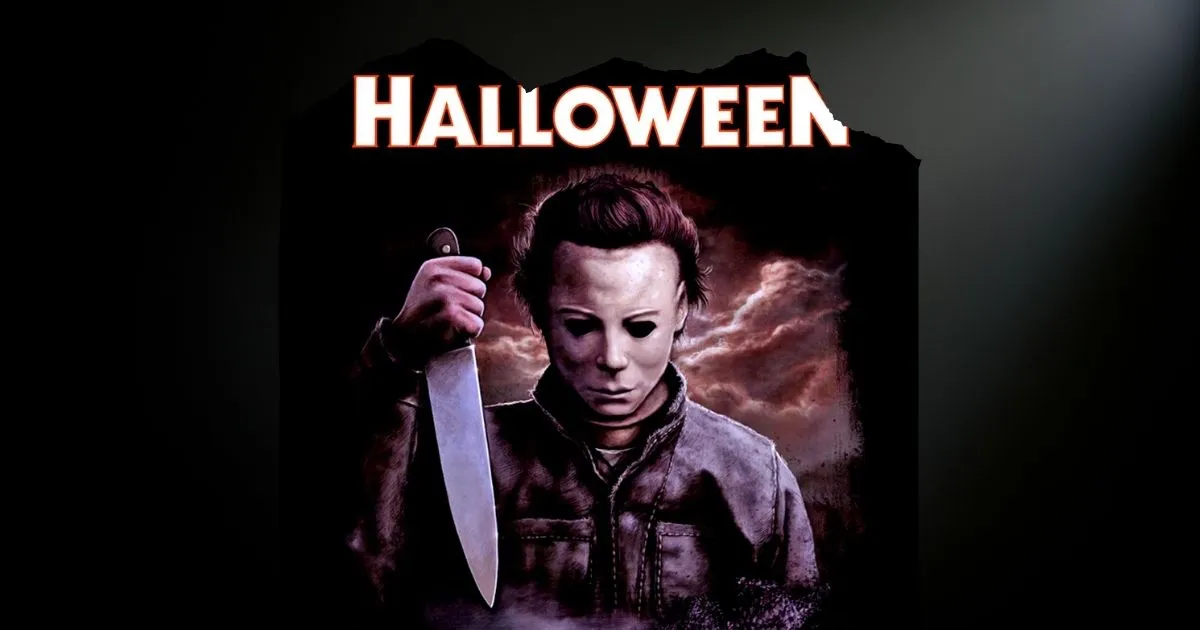
The face is our emotional identity card. It conveys anger, fear, joy, shame — a micro-theatre where humanity performs itself. This is why Michael Myers’s mask acts like a psychic explosion: a white, frozen face, without eyebrows or pupils, erasing every trace of emotion.
When confronted with him, our social brain — wired to decode others’ intentions through facial expressions — is abruptly disoriented. What we fear is not the monster, but the absence of anything human.
The Brain and the Impassive Face: When a face shows no emotion, the brain goes on alert. Neuro-imaging studies show that the amygdala, the brain’s fear center, activates more strongly in front of a neutral face than an angry one. Why? Because the unpredictable is more threatening than the hostile. A frozen face short-circuits our social prediction circuits: we cannot foresee what it will do — and that uncertainty is precisely what frightens us.
Carpenter films Michael Myers as an unstoppable presence — an entity without affect, voice, or past. Dr. Loomis describes him as “pure evil.” But this evil is not demonic — it is clinical. Michael acts without remorse or visible excitement, as if his violence resulted from a defective emotional circuit — a cortex disconnected from empathy.
Psychologically, he embodies what psychiatrist Hervey Cleckley called the mask of sanity: the calm, polite façade concealing a total affective void. Carpenter takes the idea further: here, the mask is no longer a disguise — it is the face itself. Humanity disappears, leaving only a predatory function, a gaze without subject.
And that may be Carpenter’s true genius: Halloween does not just invent a killer; it creates a metaphor for psychic nothingness. What if fear did not reside in the monster, but in our own gaze? Carpenter’s camera is about to test that hypothesis — literally.
Seeing through evil: how Halloween turns our eyes against us
The film opens with a three-minute unbroken tracking shot, filmed entirely in subjective camera. We see through the eyes of an unknown figure. The camera advances slowly through a house, observing, almost breathing. It crosses thresholds, climbs stairs, seizes a kitchen knife — and strikes.
This opening is one of the most famous in horror cinema. It draws us inside the killer’s consciousness, denying us the moral distance of spectatorship. When the mask falls to reveal six-year-old Michael holding the weapon, the shock is total: fear no longer stems from the monster, but from having seen through his eyes.
This device is devastatingly effective. Carpenter doesn’t show evil — he installs it in our perception. Cognitive psychology would later call this involuntary identification: when perspective forces the viewer to adopt the point of view of an act they reject. The brain cannot defend against it; it merges, for an instant, with the agent of fear.
Even when the camera later returns to a “neutral” angle, the disturbance persists. We think we are watching Michael, but we still feel what he sees. The film has contaminated our perception.
Throughout Halloween, Carpenter repeatedly triggers this perceptual trap. A human shape between trees, a mask behind a curtain, a simple change of music — each reactivates that first moment of dread. Everything appears calm, but the brain remains on alert.
In this sense, Halloween anticipated modern discoveries in the neuroscience of perception: fear depends not only on what is seen but on the state of expectation the brain maintains. Carpenter does not need to show violence — he has embedded it in anticipation. More importantly, he has forged the codes of fear — those invisible rules that became the grammar of modern horror.
The subjective long take, the repetitive minimalist score, the threatening off-screen space, the slow calculated camera movements — all have since become the universal syntax of dread. The camera, like an optical virus, shifts fear from the killer to the viewer — and that transfer became the genre’s signature.
🔗 Read also: The shining: The enduring terror of Stanley Kubrick
The peaceful suburb: when the everyday turns menacing
Halloween’s true power lies in the fact that fear lives not in darkness but in light. Carpenter avoids Gothic castles and wet alleys; he films the tidy streets of a quiet suburb bathed in crisp autumn brightness. Tree-lined sidewalks, children in costumes, calm façades — everything breathes normality. And yet something feels off.
This banality becomes threatening when it collides with the viewer’s sensory memory. Carpenter programs our fear from the very first minutes: the steady synthetic theme acts as a Pavlovian danger cue. Whenever it returns — even over a neutral image, a swing moving in the breeze — the brain associates it with menace. Everyday life becomes contaminated.
This terrifying efficiency rests on a simple neuroscientific principle: fear is contextual. An image alone is not frightening; the mental frame surrounding it gives it emotional charge. Carpenter transforms reality into a nightmare setting without altering its appearance. Fear is no longer a special effect — it is an interpretative effect.
His long static shots heighten this tension of expectation. Nothing moves, but everything could. The spectator’s eye, conditioned to seek threat, scans for signs: a curtain, a silhouette, a mask that might be there — or not.
This diffuse tension makes the film a near-behavioral experience: the spectator learns to fear the familiar. Thus emerges one of the key codes of fear — domestic anxiety. Where earlier horror located danger in the exotic or monstrous, Halloween installs it next door. The home, symbol of safety, becomes a trap.
Behind the white fences of the American dream trembles the collective unconscious — a society where violence no longer needs an elsewhere. This slide from the everyday to the menacing echoes the adolescent psyche: the age when innocence and fear meet, and death enters experience for the first time.
🔗 Explore further: The thrill of fear : How the brain turns terror into pleasure
Growing up with fear: adolescence and the awakening of death
Beneath its slasher surface, Halloween stages a deeper drama: adolescence confronted with death. Michael’s victims are young and carefree, discovering freedom through transgression. Their world of music, flirtation, and irony collides with the gravity of lurking evil — a moral tension that gives the film its charge.
The Slasher Genre: Anatomy of a Ritualized Fear: The term slasher comes from the verb to slash. It names a sub-genre of horror that emerged in the late 1970s, with Halloween as its founding model: a masked killer stalks a group of youths in a confined space — a house, a camp, a high school — until the final confrontation with a survivor, the final girl.
American horror cinema of the ’70s was often read as a Puritan allegory: teens who smoke, drink, or have sex “pay” symbolically with their lives. But Carpenter does not moralize. He portrays the collision of innocence and vulnerability. His characters are not punished; they are caught off guard in a world where innocence no longer protects.
At the heart of this mechanism stands Laurie Strode, played by a very young Jamie Lee Curtis. Her concentrated face, hesitant posture, and calm gestures make her a heroine against the genre’s clichés. She is neither invincible nor provocative — she is attentive. While her friends laugh, Laurie observes, listens, senses. Her emotional intelligence becomes her survival tool. She embodies one of horror cinema’s most enduring archetypes: the final girl — the one who survives through lucidity and restraint.
Yet for Carpenter, survival has a cost. When Laurie stabs Michael for the first time, she does not become a hero but a witness. Her final gaze is not victory but trauma. She has seen what others refused to see: the brutal crossing from childhood into awareness of evil.
Carpenter orchestrates this transition with clinical precision: laughter freezes, music distorts, daylight turns toxic. At the center of it all emerges a truth: fear is the price of lucidity.
🔗 Discover more: Kafka’s Metamorphosis and the voice of silence
Halloween as a mirror of collective fear
On the surface, Halloween tells the story of a masked killer. But behind Michael Myers’s face, Carpenter dissects an entire society — an anxious America obsessed with domestic safety and appearances. The holiday meant to exorcize fear through disguise becomes its opposite: fear reclaims reality.
The bogeyman no longer comes from fairy tales — he comes from across the street. In the 1970s, the United States was gripped by insecurity: economic crisis, media-driven serial-killer cases, social fractures. Halloween crystallizes this collective unease.
Beneath its horror-fiction veneer, the film says something essential: danger is no longer elsewhere — it is inside the house, within the family, within the psyche. The monster does not come from another world — it comes from ours.
Carpenter films this intimate fear without speeches or special effects. He lets it seep into normality like invisible current. Symbolically, Halloween mutates the very myth of horror.
The film thus functions as a cultural mirror: it reflects our shadow zones while teaching us how to tame them. That is why Halloween still resonates more than forty years later. It does not merely frighten — it organizes fear. It reveals its mechanics, transforms it into language, culture, and code.
And behind Michael Myers’s mask, Carpenter left an enduring warning: what we fear most is not the monster outside — but the unknown we carry within.
References
Asok, A., et al. (2019). The Neurobiology of Fear Generalization. Frontiers in Behavioral Neuroscience.
Bakare, L. (interview de) / Carpenter, J. (2017). John Carpenter: ‘Could I succeed if I started today? No. I’d be rejected’, The Guardian.
Clover, C. J. (1992). Men, Women, and Chain Saws: Gender in the Modern Horror Film. Princeton University Press.
Carroll, N. (1990). The Philosophy of Horror: Or, Paradoxes of the Heart. Routledge.
Dika, V. (1990). Games of Terror: “Halloween,” “Friday the 13th,” and the Films of the Stalker Cycle. Fairleigh Dickinson University Press.
Prince, S. (2004). The Horror Film. Rutgers University Press.

Amine Lahhab
Television Director
Master’s Degree in Directing, École Supérieure de l’Audiovisuel (ESAV), University of Toulouse
Bachelor’s Degree in History, Hassan II University, Casablanca
DEUG in Philosophy, Hassan II University, Casablanca