Dyspraxia: How the body teaches the brain
Picture a seven-year-old seated at a school desk. Classmates have already filled two lines in cursive; he is still wrestling with the first letter of his name. The pen trembles, the page crumples, a bead of sweat forms on his forehead. What is effortless for others becomes a struggle for him. This child is not lazy, inattentive, or “clumsy” in the everyday sense. He is dyspraxic.
Developmental Coordination Disorder (DCD)—still often called dyspraxia—affects roughly 5–7% of school-age children (Blank et al., 2019). In a class of 30, that means about two children. Nevertheless, dyspraxia remains an invisible condition, frequently misunderstood or mistaken for attention problems or simple carelessness.
Behind those hesitant gestures lies a complex neurological reality. The good news: the brain is not fixed. Thanks to neuroplasticity, it can compensate, reorganize, and invent new strategies. This is precisely where psychomotor therapy reveals its strength: by turning the body into a living laboratory, it helps children build new neural pathways.
From intention to action: Where the sequence breaks
Dyspraxia—now more accurately termed Developmental Coordination Disorder (DCD)—is far more than a “lack of dexterity.” It does not result from low intelligence, poor effort, lax parenting, or simple inattention. It is a neurological alteration affecting the programming, planning, and automatization of voluntary actions.
Everyday actions—holding a pen, tying laces, catching a moving ball—depend on an extraordinarily complex neural sequence. Beneath the apparent simplicity of a gesture lies a cerebral orchestra in which each structure plays its part. The parietal cortex builds the spatial and visual map of the intended action; the premotor cortex and motor areas organize the sequence; the cerebellum refines precision, fluidity, and online error correction; and the corpus callosum harmonizes interhemispheric communication. These regions do not work in isolation; they form dynamic networks linking perception, cognition, and movement.
In dyspraxia, this network loses synchrony. Information flows, but it is noisy, slowed, or incomplete. The orchestra is out of tune: some instruments come in late, others stop too soon, and the rhythm hesitates. Movements appear jerky, imprecise, and energy-consuming. It is not that the child does not know what to do; the difficulty is automatizing what has been understood and learned.
Neuroimaging research supports this picture. Studies by Wilson and colleagues, among others using functional MRI, show atypical connectivity across parieto-frontal circuits and reduced efficiency in cerebello-motor communication. This weaker integration hinders anticipation and context-dependent adjustment of movement. The basal ganglia, which participate in selecting and automatizing motor programs, also show atypical activity—helping explain why even simple actions demand constant effort.
In daily life, these neurological desynchronizations translate into many practical challenges. Dressing becomes a trial: pulling on a sweater, zipping a jacket, or buttoning a shirt can feel like a small mountain to climb. In class, writing a single sentence may require disproportionate effort: the hand shakes, letters drift off the line, and speed lags far behind peers. In physical education, catching a ball or chaining jumps can trigger anxiety, as movements appear disorganized.
🔗 Read also: The moving mind: Why psychomotricity builds more than muscles
The psychological consequences are considerable. Frustration sets in; the child feels “less capable,” dreads teasing, and may develop low self-esteem. Developmental psychology studies highlight increased risks of anxiety and diminished self-confidence in children with DCD. When every routine action is a struggle, a negative self-image can take root and persist into adulthood.
Consider Sami, age 8, followed in psychomotor therapy. Mornings, dressing can take more than twenty minutes, creating constant family tension. At school, he avoids ball games for fear of failure in front of classmates. In sessions he often says, “It feels like running a marathon just to write a page.” Many dyspraxic children share this reality: enormous physical and emotional expenditure for tasks other children perform spontaneously and without effort.
Dyspraxia is thus not “mere clumsiness.” It is a neurodevelopmental condition that touches motor planning networks, sensory integration, and the child’s emotional and social world. It reminds us that human movement is never purely mechanical; it is rooted in a living dialogue between brain, body, and environment.
Brain under renovation
For a long time, scientists believed the brain was essentially “finished” after childhood. Until the 1970s, dominant models posited that after a so-called critical period—childhood and adolescence—neural circuits set like cement. Brain lesions were thought irreversible; the adult brain, unchangeable. This pessimism was overturned by pioneering work from Michael Merzenich and others, showing first in animals and then in humans that the brain can remodel throughout life. We now know with certainty that the brain is a plastic, malleable organ—perpetually under construction.
In childhood, plasticity is especially exuberant. During the early years, the brain produces millions of new synapses every second, often likened to a lush tropical forest. Each experience, each repeated movement or discovery, engraves a trace in this neural ecosystem. A child who climbs, runs, and manipulates objects is not merely playing; they are sculpting the brain, laying down pathways that support later learning.
Psychomotor therapy harnesses exactly this principle. It relies on varied repetition of motor experiences—not as a constraint but as a source of pleasure and motivation. Each activity—throwing a ball, tracing shapes, navigating an obstacle course—is a chance to strengthen an existing circuit, create a new one, or reorganize connections. By multiplying attempts and small wins in a supportive setting, the dyspraxic child “rehabilitates” the brain—often without realizing it.
Take Lina, age 7, who struggled to write her first name. After months of playful psychomotor work—fine-motor games, drawing in sand, large graphic gestures on a wall board—her coordination and movement fluidity improved markedly. This is not just conscious skill learning; it reflects neural reorganization within visuomotor coordination networks, as many plasticity studies have shown.
Plasticity is not an abstract lab concept. It is a tangible, everyday process visible in each small step forward. In dyspraxia, it is a powerful resource: even when some circuits are inefficient, the brain can reinvent solutions, explore alternative routes, and build durable compensations.
🔗 Explore further: Where body and mind meet: The crossroads of psychomotricity
Psychomotor therapy
Psychomotor therapy rests on a key conviction: the body is simultaneously motor, cognitive, and emotional. Working on movement is not simply about perfecting technique; it is about reconciling the child with their body and restoring continuity between felt experience, imagination, and action.
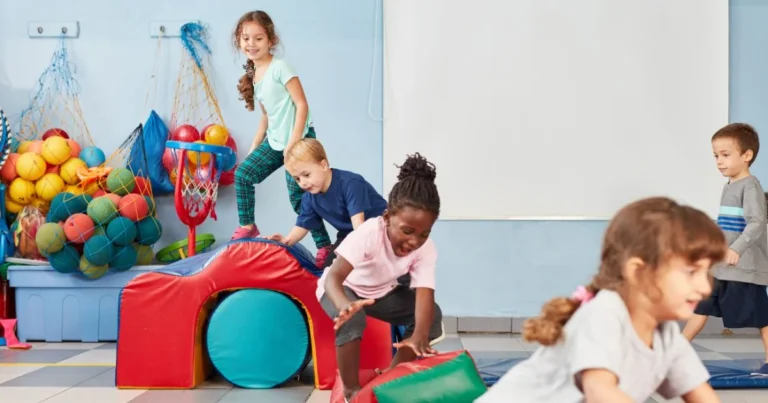
School often demands rapid results—write a line, cut on the line, catch the ball. Psychomotor therapy offers a different space: a humane setting for experimentation, where the child has the right to try, fail, and try again. Mats, balls, ropes, and sand are not mere props; they are mediators. Each activity lets the child face difficulties while discovering new ways of acting. This is not mechanical repetition; it is the mobilization of the whole person, where motor, cognitive, and emotional dimensions interweave.
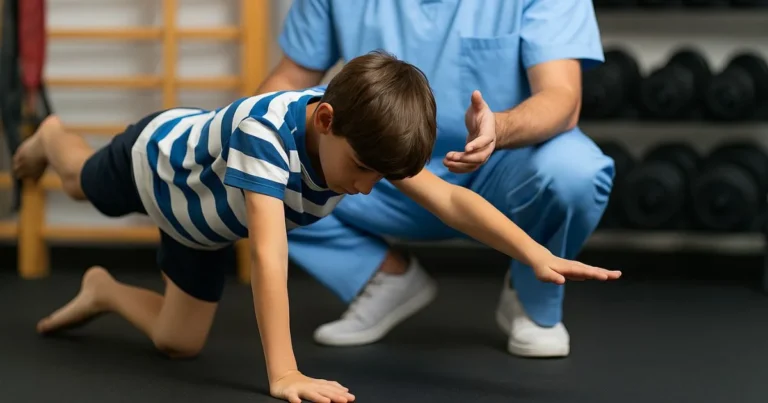
A founding principle here is progressivity. A dyspraxic child will not master a complex action—legible writing or shoe-tying—overnight. The therapist proceeds step by step, a genuine pedagogy of detours: from broad, global movements—drawing circles in the air, walking a line, rolling a ball—to finger precision and oculomanual coordination. This pathway primes the brain, first engaging general sensorimotor networks before consolidating specialized circuits.
Emotion matters just as much. Research in affective psychology (notably Antonio Damasio and Mary Helen Immordino-Yang, 2007) shows that learning cannot be separated from feeling. Stress engages limbic circuits that inhibit attention and memory; confidence and enjoyment engage dopaminergic reward systems that boost motivation and consolidation. Psychomotor therapy leverages this: play and pleasure are engines of learning, not mere rewards.
Each session becomes a living laboratory where the child explores limits at their own pace. The therapist validates every small success as a step toward autonomy. An imperfect movement performed without help is a personal—and neurological—victory.
Karim, age 8, refused PE and was always picked last. In therapy, he began by throwing a ball at a fixed target, then a moving one. Each step brought positive feedback that strengthened confidence. Weeks later, he had not only improved eye-hand coordination; he had rediscovered the joy of playing with others and reclaimed his place in group games.
Psychomotor therapy thus reconciles the child with the body. Where dyspraxia often installs a sense of failure, therapy restores an inner narrative: “my body can succeed,” “I am capable,” “I can learn differently.” These quiet statements are fertile ground for neuroplastic change.
🔗 Discover more: Mental health begins in the body
Move to learn, learn by moving
Dyspraxia reminds us that human action is a finely tuned orchestration. Beneath any simple movement—buttoning a shirt, tracing a letter, catching a ball—lies a delicate coordination among planning, perception, and execution. When this balance falters, the child meets invisible obstacles: the line that veers despite effort, the impossible lace, the weight of others’ gaze. Clumsiness becomes a lived experience of mismatch between intention and action.
Nothing is fixed. The brain remains plastic, shaped by experience. Each attempt—awkward or not—gradually redraws neural circuits. Movement is not only an output of the brain; it is also one of its architects. The psychomotor therapist does not simply “correct” a gesture; they rebuild trust between body and thought, opening new routes. By valuing process over performance, the child learns to reconnect feeling, imagination, and action. Movement becomes language, experimental ground, a laboratory of life.
In the end, psychomotor therapy is not a correction but a rewriting of the living. It opens possibilities where there seemed only dead ends. Perhaps that is its most precious lesson: we are beings of movement, and by moving—awkwardly at times, earnestly always—we sculpt our brains and discover the freedom to learn differently.
References
Blank, R., Smits-Engelsman, B., Polatajko, H., & Wilson, P. (2019). European Academy for Childhood Disability (EACD): Recommendations on the definition, diagnosis and intervention of developmental coordination disorder. Developmental Medicine & Child Neurology, 61(3), 242–285.
Immordino-Yang, M. H., & Damasio, A. (2007). We feel, therefore we learn: The relevance of affective and social neuroscience to education. Mind, Brain, and Education, 1(1), 3–10.
Merzenich, M. M. (2001). Cortical plasticity contributing to child development and learning. Mental Retardation and Developmental Disabilities Research Reviews, 7(4), 289–295.
Wilson, P. H., Ruddock, S., Smits-Engelsman, B., Polatajko, H., & Blank, R. (2013). Understanding performance deficits in developmental coordination disorder: A meta-analysis of recent research. Developmental Medicine & Child Neurology, 55(3), 217–228.
Zwicker, J. G., Missiuna, C., Harris, S. R., & Boyd, L. A. (2012). Brain activation of children with developmental coordination disorder is different than peers. NeuroReport, 23(8), 463–468.
Saad Chraibi
Psychomotor Therapist
• A graduate of Mohammed VI University in Casablanca, currently practicing independently in a private clinic based in Casablanca, Morocco.
• Embraces a holistic and integrative approach that addresses the physical, psychological, emotional, and relational dimensions of each individual.
• Former medical student with four years of training, bringing a solid biomedical background and clinical rigor to his psychomotor practice.
• Holds diverse professional experience across associative organizations and private practice, with extensive interdisciplinary collaboration involving speech therapists, psychologists, neuropsychologists, and other healthcare professionals.
• Specializes in tailoring therapeutic interventions to a wide range of profiles, with a strong focus on network-based, collaborative care.
• Deeply committed to developing personalized therapeutic plans grounded in thorough assessments, respecting each patient’s unique history, pace, and potential, across all age groups.