When Alzheimer’s disrupts the body’s inner map
Alzheimer’s is often associated with forgetting. Yet it also reshapes how the body acts and situates itself in space, making even movement itself an unstable reference.
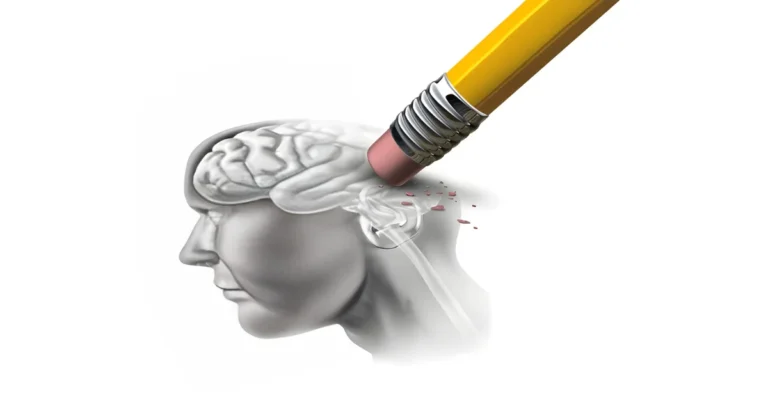
In the public imagination, Alzheimer’s disease is often reduced to a simple problem of memory. Forgetting names, faces, dates, or appointments is treated as the defining feature. While this picture is partly true, it is also deeply incomplete. It hides the complexity of a neurodegenerative disorder that gradually disrupts the person as a whole.
First described in 1906 by the German neurologist Alois Alzheimer, the disease is not limited to the fading of memories. Over time, it affects brain systems involved in orientation, language, action planning, emotional regulation, and the perception of one’s own body. As the illness progresses, it is not only memory that becomes unstable, but also a person’s relationship to the world, to others, and to themselves.
The body, once familiar and self evident, can start to feel strange. Movements lose their spontaneity, walking becomes uncertain, and space itself can feel fragmented. Emotions, sometimes poorly regulated, spill into daily life as diffuse anxiety, agitation, withdrawal, or disinhibition. Gradually, the sense of existing in a continuous and coherent way becomes more fragile.
Understanding Alzheimer’s disease therefore requires going beyond a strictly cognitive view and recognizing the global impact on the person, including psychological, bodily, and relational dimensions. It is precisely at this subtle interface, where brain, body, and emotion intertwine, that psychomotor therapy finds its full meaning.
🔗Explore further: How the human brain works
Alzheimer’s in the brain, felt in the body
Alzheimer’s disease is a complex, progressive neurodegenerative disorder, defined by a gradual and irreversible impairment of brain structures essential for cognitive, sensory, motor, and emotional functioning. At the neurobiological level, this degeneration is linked to abnormal accumulations of proteins, including amyloid plaques and tau tangles, which disrupt communication between neurons and ultimately contribute to neuronal death.
Among the earliest regions affected is the hippocampus, a key structure for episodic memory and spatial orientation. Its impairment helps explain early complaints, repeated forgetting, difficulty encoding new information, and loss of temporal landmarks. However, the disease does not stop there. It gradually extends to associative cortical regions, which integrate sensory, motor, emotional, and cognitive information to produce actions that are appropriate, smooth, and coherent.
In the early phase, clinical signs are mainly cognitive: recent memory impairment, word finding difficulties, slowed thinking, and disorientation in time and space. These symptoms are easy to identify, so they naturally dominate medical and social attention. However, an exclusively cognitive reading remains incomplete. As the degeneration advances, impairment spreads beyond intellect and affects overall psychomotor functioning.
Psychomotor functioning refers to how the brain organizes movement, inhabits the body, and enables intentional action in the environment. In Alzheimer’s disease, this organization gradually weakens. The body, once familiar and automatic, becomes a source of uncertainty. Everyday gestures lose fluidity, precision, and their natural sequencing.
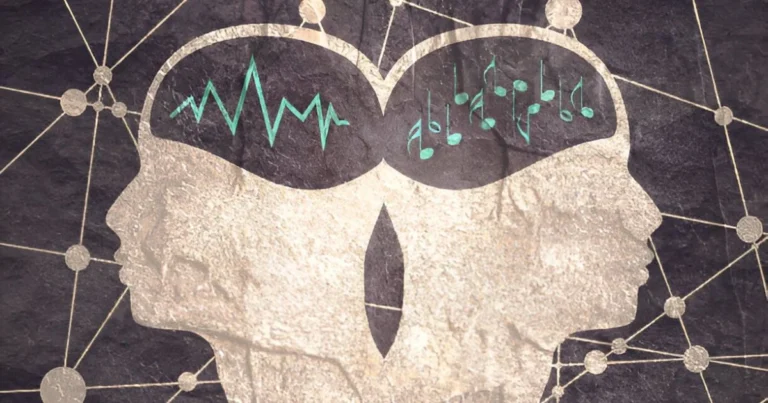
🔗Read also: Why music endures when memory fades in Alzheimer’s disease
Simple actions learned long ago, standing up from a chair, walking, buttoning clothing, using cutlery, brushing teeth, can become unexpectedly difficult. This is not a matter of motivation or muscle weakness, but can reflect apraxia, a disturbance of the ability to plan and sequence learned actions despite preserved strength and basic understanding.
In parallel, the body schema, the largely implicit internal representation of the body, can become disorganized. The person may struggle to locate limbs in space, coordinate movements, or adjust posture. This altered bodily experience often produces growing motor insecurity, with slower and more cautious gait, occasional freezing, and increased risk of imbalance and falls.
The relationship to space is also profoundly changed. Places that were once familiar can become confusing. A person may get lost at home, misjudge distances, hesitate in front of obstacles, or fail to anticipate turns. This disorientation is not purely cognitive. It is also bodily, reflecting difficulty locating oneself physically in the environment.
These motor and perceptual changes are often accompanied by major emotional consequences. Loss of bodily landmarks, postural instability, and reduced motor control can generate anxiety and agitation, or, conversely, psychomotor slowing and withdrawal. When words become scarce, emotional expression increasingly passes through behavior, movement, posture, and attitude rather than speech. Neuropsychiatric symptoms such as anxiety, agitation, and mood changes are common in dementia, including Alzheimer’s disease.
These psychomotor manifestations should never be treated as secondary. They are integral to Alzheimer’s disease and contribute to psychological suffering, loss of functional autonomy, and behavioral symptoms. Broadening Alzheimer’s from a purely cognitive disorder to a disorder of the brain and lived bodily experience opens the way to more global and more humane care.
Psychomotor therapy as a compass for daily life
Psychomotor therapy rests on a core principle: the body, emotions, and cognitive functions form an inseparable whole. Thinking, feeling, and acting are not isolated processes. They interact continuously through overlapping neural networks. In Alzheimer’s disease, brain changes therefore inevitably affect posture, tone, movement, rhythm, and expressivity. Conversely, bodily experiences can modulate emotions and influence remaining cognitive capacities.
In this context, the goal is not to restore past performance or to “fix” a deficit in a classic rehabilitative sense. The work is supportive: preserving what remains, slowing decline where possible, compensating emerging vulnerabilities, and accompanying the person through progressive change.
A central aim is to maintain continuity of bodily experience. Even when cognition deteriorates, the body remains a fundamental support for identity. Sensory, emotional, and procedural memories can be relatively more resilient than explicit declarative memory in earlier stages, providing important clinical levers for care.
Psychomotor care begins with a fine grained, individualized clinical assessment. Rather than listing deficits, it seeks to understand overall functioning. It examines muscle tone, which can fluctuate, balance, global and fine coordination, motor rhythm, posture, gait quality, and how the body adapts to the environment.
It also explores how the person inhabits their body. Do they feel safe or insecure. Is the body actively engaged or avoided. Is there agitation, rigidity, slowness, or a reduction in gesture. These observations inform both neurological status and emotional and relational experience.
Assessment also fully integrates affect. Anxiety, psychomotor agitation, irritability, oppositional behavior, and withdrawal are frequent. Often these are not simply “behavior problems” but bodily responses to internal disorientation, environmental misunderstanding, or profound insecurity. Guidance is adapted accordingly, with the aim of decoding what the body expresses when verbal language weakens.
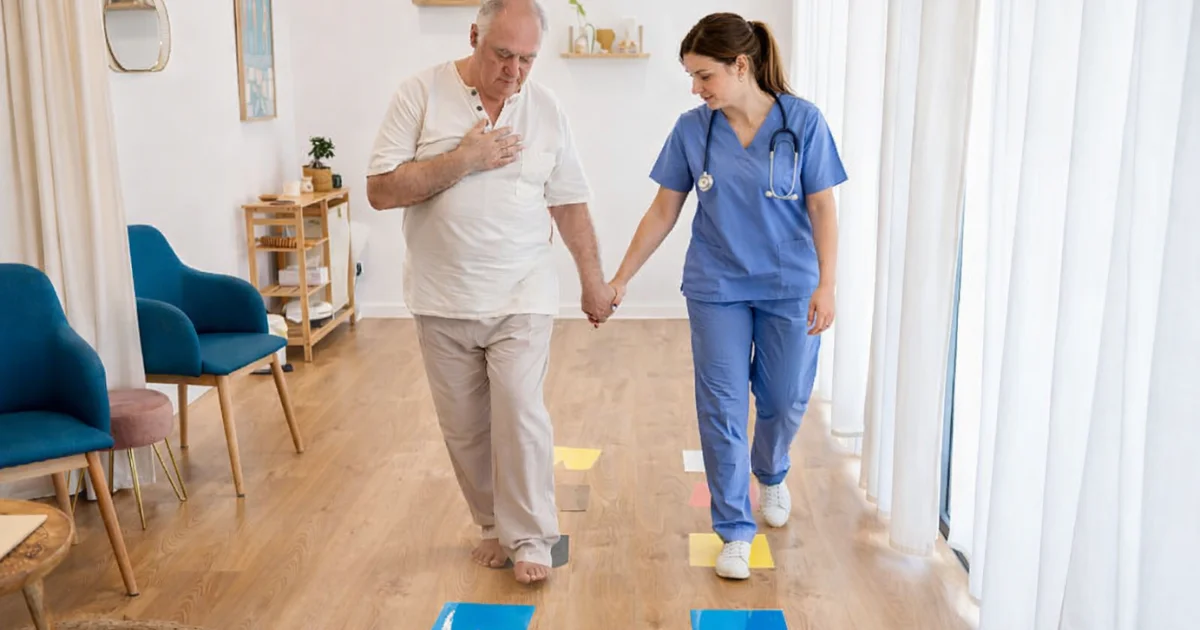
Interventions rely on simple, repetitive, reassuring body based activities, chosen according to disease stage and the person’s capacities on that day. Supported walking can engage motor and balance systems, stimulate spatial orientation, and improve postural adjustments, while also helping regulate anxiety. Rhythm based games mobilize coordination and timing and can harness procedural memory. Relaxation and body calming techniques can support autonomic regulation, reduce agitation, and strengthen internal safety.
🔗Explore further: Aging: Inside the silent X chromosome
Body schema work aims to reinforce awareness of bodily boundaries, points of support, and limb localization, which can support mobility and reduce falls risk. Sensory stimulation, tactile, proprioceptive, vestibular, can activate pathways that may remain relatively responsive and help anchor the person in the present moment.
Beyond techniques, the therapeutic relationship is central. The clinician’s presence, their tone and pacing, the repetition that reassures, and a stable framework provide essential containment. In a disease where cognitive landmarks fade, bodily and relational continuity can become an emotional and practical anchor.
Preserving movement, preserving identity
Movement is never purely mechanical. It is the visible outcome of complex neurological, emotional, and relational processes. Each gesture reflects brain networks, personal history, bodily habits, and a way of engaging with the world. Movement is a language. It expresses intention and emotion, and it shapes relationships. When speech becomes fragile, the body continues to communicate through posture, tone, rhythm, gaze, and gesture.
In Alzheimer’s disease, preserving movement is not only about maintaining functional mobility. It is about preserving a way of being in the world. Continuing to move, explore space, and feel one’s body supports a sense of identity continuity, even when autobiographical memory and language weaken.
This approach is grounded in the observation that some forms of memory, including aspects of procedural learning, can be relatively more preserved earlier than explicit recall, because they rely on partially different neural systems. Psychomotor interventions mobilize these resources through familiar, meaningful, repetitive actions.
Practically, this means working with simple, well known gestures that carry personal meaning. Re establishing a steady walking rhythm, practicing safe transfers, or handling familiar objects can reactivate deeply learned motor patterns. Even modest successes reinforce recognition of self and personal continuity.
Psychomotor sessions can become a space where the body returns to being a point of support rather than a source of fear. Stabilizing posture, improving balance responses, supporting coordination, and clarifying spatial cues often reduces anxiety and agitation. Many behaviors labeled as “disturbances” can be rooted in bodily and spatial insecurity. Addressing underlying distress with non drug approaches is explicitly emphasized in dementia guidance.
Fall prevention is also fundamental, given the frequency and consequences of falls in dementia and the links between balance, gait, and cognitive decline. But beyond risk reduction, preserving movement is also preserving dignity: enabling the person to remain an agent of their own gestures, even simple ones, and to experience the body as alive and meaningful.
🔗Explore further: Where body and mind meet: The crossroads of psychomotricity
Reassuring the body without restraining it
When words gradually disappear and verbal communication becomes difficult, the body becomes a primary channel of meaning. Gaze, posture, gesture, and professional, reassuring touch can carry communication and comfort.
Ethically, the foundation is respect for the person: dignity, autonomy, and bodily integrity. Psychomotor interventions must be guided by consent, even when expressed non verbally, and must respect each person’s pace and limits. The clinician supports without forcing, guides without imposing, reassures without infantilizing, and avoids reducing the person to a diagnosis.
This relational approach protects self esteem and the feeling of being recognized despite cognitive losses. The body becomes a key medium of emotional expression when language fails. Psychomotor therapy also fits within multidisciplinary care, alongside medical, nursing, speech therapy, occupational therapy, and psychological support, bringing a distinctive focus on embodied experience and relational presence.
🔗Read also: Happiness and the brain: Can wellbeing slow cognitive decline?
The body as a bridge when speech declines
Supporting a person with Alzheimer’s disease is not only about resisting cognitive loss. It is also about recognizing what remains accessible: bodily sensations, motor rhythm, familiar gestures, shared emotions. As verbal language deteriorates, the body can become a central channel of connection.
This is partly because sensory and motor pathways, and some forms of procedural and emotional responsiveness, can remain workable earlier in the disease. Psychomotor therapy builds on these capacities through structured and reassuring bodily experiences that engage remaining networks and support continuity and a sense of control.
Walking in synchrony, rhythm activities, guided gestures, and shared movements are not only motor exercises. They also support emotional expression, reduce anxiety, and strengthen bodily confidence, which can improve quality of life and ease relationships. The clinician continuously adjusts to tone, posture, breathing, facial expression, and movement quality, turning each gesture into a relational tool.
Alzheimer’s disease is more than memory loss. It affects brain function, the body, emotions, and how a person situates themselves in the world. Understanding it as a disorder of lived bodily experience as well as cognition broadens clinical perspective and supports truly person centered care.
Psychomotor therapy offers a unique frame for this reality. As long as the body can feel, perceive, and act, connection remains possible. Through guidance, rhythm, coordination, and sensory engagement, psychomotor approaches can support remaining capacities, regulate anxiety and agitation, improve safety in movement, and facilitate emotional expression.
Beyond techniques, it highlights the essential role of human presence. Each shared gesture can carry meaning, recognition, and dignity. In a disease that gradually erodes words and memories, the body can become memory, language, and a guiding thread. Through its global and humane approach, psychomotor therapy reminds us that as long as the body can express itself, the person remains present and in relation to the world.
Saad Chraibi
Psychomotor Therapist
• A graduate of Mohammed VI University in Casablanca, currently practicing independently in a private clinic based in Casablanca, Morocco.
• Embraces a holistic and integrative approach that addresses the physical, psychological, emotional, and relational dimensions of each individual.
• Former medical student with four years of training, bringing a solid biomedical background and clinical rigor to his psychomotor practice.
• Holds diverse professional experience across associative organizations and private practice, with extensive interdisciplinary collaboration involving speech therapists, psychologists, neuropsychologists, and other healthcare professionals.
• Specializes in tailoring therapeutic interventions to a wide range of profiles, with a strong focus on network-based, collaborative care.
• Deeply committed to developing personalized therapeutic plans grounded in thorough assessments, respecting each patient’s unique history, pace, and potential, across all age groups.