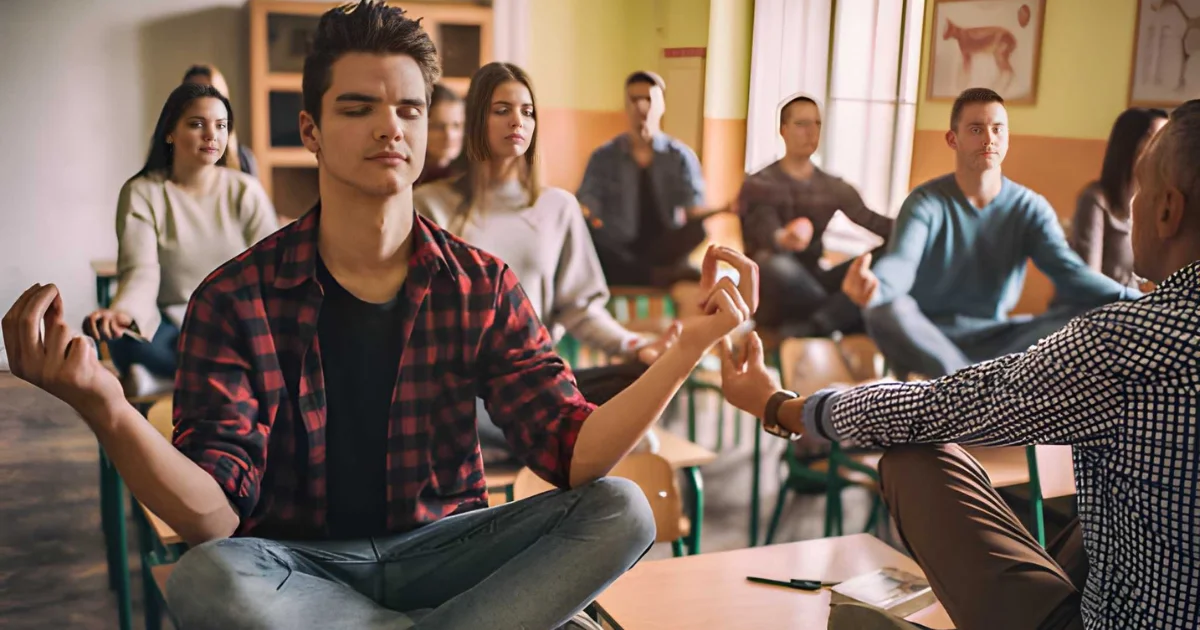
Mindfulness at school between promise and scientific reality
Promoted as a tool for attention and academic success, meditation in schools has gained broad appeal. Yet scientific evidence paints a more contrasted picture, where benefits exist but fall short of expectations.
Over the past few years, mindfulness meditation sessions have steadily made their way into schools, from primary classrooms to high schools. This growing interest is rooted in a simple idea. A few minutes of guided breathing or focused attention on the present moment might help students manage stress more effectively, improve concentration, and feel more mentally balanced. The promise has appealed to teachers, school administrators, and parents alike, all searching for ways to respond to rising academic pressure and emotional distress among young people.
At the same time, this enthusiasm raises legitimate questions. Beyond media attention and well-intentioned claims, what do scientific studies actually show? Does meditation make students more attentive in class? Does it improve learning outcomes? Or does it mainly influence psychological well-being? Between educational expectations and evidence-based findings, the gap deserves closer examination.
🔗Explore further: How the human brain works
Where mindfulness helps and where it falls short
Recent scientific research points to a relatively consistent conclusion. When introduced in schools, mindfulness meditation primarily affects students’ emotional experience. Across many studies, children and adolescents report lower perceived stress, a better ability to identify their emotions, and a modest reduction in anxiety. These effects are neither dramatic nor universal, but they appear frequently enough to be considered reliable. They are especially noticeable during adolescence, a developmental stage marked by heightened emotional sensitivity and increasing social and academic pressures.
However, these emotional benefits should not be mistaken for automatic improvements in academic performance. When researchers examine sustained attention, classroom behavior, or academic results, the picture becomes far more cautious. Some studies report slight gains, while others find no measurable effect. Overall, cognitive benefits tend to be small, inconsistent, and highly dependent on context, program duration, and student engagement. Meditation does not magically turn distracted students into models of concentration.
In other words, mindfulness seems to provide a space for emotional regulation rather than a direct tool for academic efficiency. It may help students cope better with school life, without guaranteeing improved learning outcomes. This distinction is crucial to avoid misunderstandings and to place these practices in their proper role. Mindfulness is not a miracle solution, but a potential support for students’ psychological well-being.
🔗Read also: When nature becomes a classroom
Why mindfulness cannot solve everything at school
These limitations are largely explained by the way meditation is practiced in schools. In most cases, it consists of brief exercises inserted into already crowded schedules and delivered over relatively short periods. Under such conditions, mindfulness cannot offset the weight of academic demands, social inequalities, or deeper psychological difficulties. It operates within a highly structured environment that leaves little room for lasting changes in learning conditions.
The way these programs are implemented also plays a decisive role. Research shows that meditation loses much of its effectiveness when it is used merely as a tool to calm students down or improve classroom discipline. When reduced to a behavioral management technique, its effects are weak or nonexistent. By contrast, outcomes are more consistent when mindfulness is embedded within a broader educational approach that values school climate, relationships between students and adults, and overall well-being.
Teachers play a central role in this process. Programs tend to be more effective when educators understand the purpose of the exercises and integrate them meaningfully rather than applying them mechanically. Meditation is not a standardized procedure that can be replicated identically in every classroom. It depends on an educational stance, the quality of relationships, and how it is explained and embodied in daily practice.
🔗Explore further: Mind wandering: A common mental state long misunderstood
Research also highlights a point often overlooked in public debate. Mindfulness does not benefit all students in the same way. Some experience genuine relief, while others show little or no measurable effect. Age, emotional state, family environment, and social context strongly influence outcomes. There is no single solution that works for everyone, nor any guaranteed benefit on a large scale.
This diversity explains the cautious stance adopted by researchers. The observed effects are real but modest. They justify neither dismissing mindfulness as a passing educational trend nor elevating it to a miracle cure for school-related difficulties. Mindfulness appears instead as a complementary tool, useful under specific conditions, but insufficient on its own to address the complex challenges facing contemporary education.
Recent research therefore calls for a more realistic interpretation of meditation in schools. Yes, it can help some students manage stress and emotions more effectively. No, it does not dramatically transform attention, learning, or overall well-being. Its value lies less in the promise of rapid results than in its ability to offer, at certain moments, a space for regulation and reflection within an often tense school environment. By clarifying what mindfulness can and cannot provide, science helps ensure it is used with greater precision, avoiding both exaggerated expectations and premature rejection.
References
Jobin, K., Nair, K. R., Ashok, L., Manjula, M., Andrews, T. J. J., Mathias, E. G., & Krishnan, P. (2025). Mindfulness-based interventions for enhancing adolescent mental health and well-being. Clinical Epidemiology and Global Health.
Monsillion, J., Zebdi, R., & Romo-Desprez, L. (2023). School mindfulness-based interventions for youth: Effects on anxiety, depression and school climate. Children, 10(5), 861.