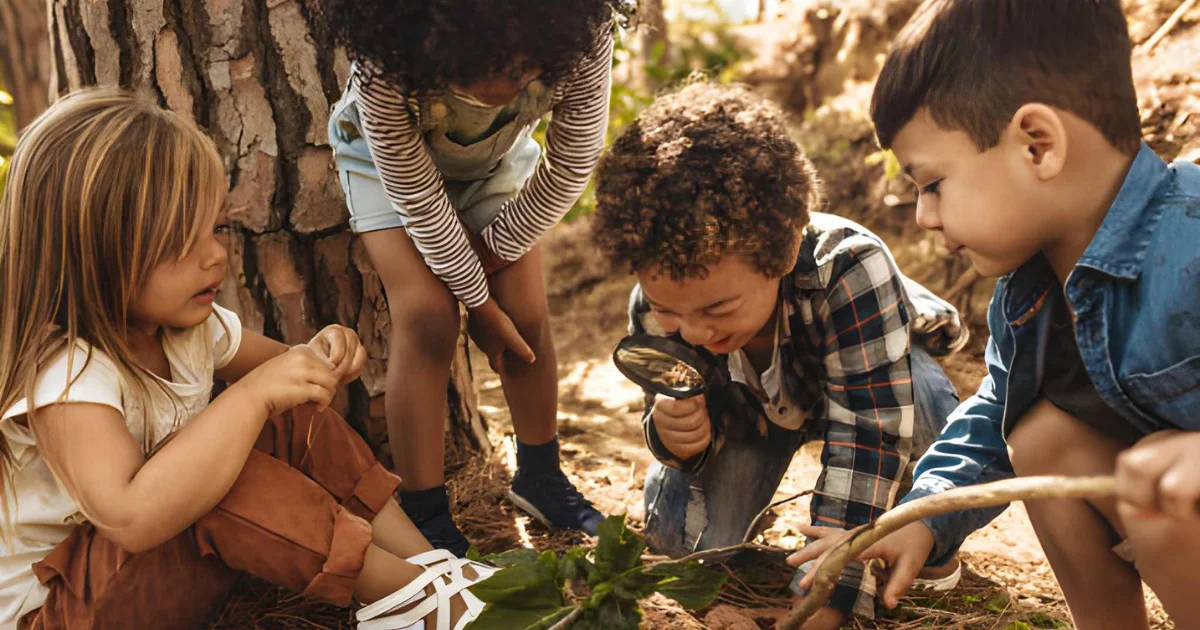
When nature becomes a classroom
Long confined to the classroom, learning is now expanding outdoors. Research suggests that natural environments can improve attention and support the cognitive processes involved in learning.
For a long time, schooling was conceived within four walls. Protective, structured, reassuring walls. Over the past decade, however, a quiet shift has been taking place in schoolyards, public parks, and sometimes at the edge of forests. What if learning outdoors were not a pedagogical whim, but a science based response to some of the challenges facing contemporary education?
Today, the body of research is sufficiently robust to support a clear conclusion. Outdoor learning is not only pleasant. It is cognitively meaningful. From a neuroscientific perspective, this idea is hardly surprising. The human brain did not evolve in enclosed rooms, seated on a chair for six hours a day. It developed over millions of years in open, dynamic environments rich in natural sensory stimulation.
Natural settings trees, grass, daylight, and subtle sound variations provide what researchers describe as moderate, non intrusive stimulation. Unlike screens, urban noise, or information overload, nature engages attention without overwhelming it. This principle lies at the core of Attention Restoration Theory, now widely supported by empirical evidence. When children are exposed to natural environments, their attentional systems can recalibrate, recover, and regain efficiency.
🔗Explore further: How the human brain works
Why stepping outside sharpens focus
Recent studies consistently show that time spent outdoors improves attentional capacities in children and adolescents. In practical terms, this translates into better concentration, reduced cognitive fatigue, and greater mental availability for learning.
This point is fundamental. Learning does not depend solely on the quality of the material being taught, but also on the state of the brain receiving that information. A brain already taxed by sustained attentional effort learns less effectively, retains less, and transfers knowledge less efficiently. Multiple studies demonstrate that even brief outdoor learning sessions produce measurable improvements in attention during subsequent classroom activities.
Outdoor learning does more than restore attention. It also changes how knowledge is embodied. Contemporary neuroscience increasingly emphasizes the concept of embodied cognition. Walking, observing, touching, and orienting the body in space actively shape mental representations. Outdoors, children do not merely hear abstract concepts. They connect them to lived experience. Measuring distances in a park, observing a real biological cycle, or reading aloud beneath a tree engage multiple neural networks simultaneously, strengthening both memory and comprehension.
🔗Read also: When learning becomes an adventure
A brain shaped for the outdoors
Students engaged in outdoor educational activities consistently show greater interest, curiosity, and active participation. From a neurobiological perspective, this effect is partly explained by activation of reward circuits. Novelty, movement, and relative postural freedom stimulate dopamine, a neurotransmitter central to learning. Outdoor classrooms do not make academic content magically easier, but they place the brain in a cognitive state that is more conducive to processing information.
Neuroscience research also shows that outdoor learning simultaneously activates several brain systems. Attentional networks, motivational circuits, and sensorimotor areas involved in movement and spatial exploration are engaged at the same time. This combined activation promotes what researchers refer to as deeper encoding of information. Knowledge is not merely heard or memorized. It is experienced. This mechanism helps explain why information acquired in concrete contexts is often better retained and more easily transferred.
This cognitive readiness aligns closely with another central concern in education today: well being. Here again, findings converge. Natural environments have a demonstrated effect on reducing physiological stress. Studies measuring cortisol levels show that time spent outdoors supports improved emotional regulation, particularly in children with attentional difficulties or heightened sensitivity to noise and crowding.
This calmer emotional climate does not only benefit individuals. It also fosters more harmonious social functioning. Research points to a reduction in minor conflicts and improved cooperation during outdoor activities. These relational effects represent a frequently underestimated lever of learning, given how strongly emotional and social states shape cognitive engagement.
A question is often raised at this point. Does learning outdoors mean learning less seriously?
Available data allow for a clear answer. Academic learning is not compromised and is sometimes enhanced, particularly in science, language, and applied mathematics. Outdoor education does not dilute academic rigor. It reshapes the learning context in ways that can strengthen effectiveness.
Outdoor environments support contextualization. Abstract concepts become more meaningful when anchored in real situations, improving both conceptual understanding and knowledge transfer. In this sense, outdoor learning acts as a meaning amplifier rather than a replacement for other teaching methods. The issue is not to oppose indoor and outdoor learning, but to integrate them thoughtfully. Researchers agree on this point. Outdoor classrooms are neither a miracle solution nor an exclusive approach. They are one pedagogical tool among others, whose effectiveness depends on consistency, coherence, and clearly defined educational intent.
Evidence suggests that only a few hours per week are sufficient to produce measurable effects. The goal is not to conduct all teaching outdoors, but to introduce variation in learning contexts that respects how the brain functions. Alternating between indoor and outdoor settings acts as a form of cognitive breathing space, renewing attention, engagement, and mental availability.
🔗Explore further: Screens and early childhood: What generation Alpha pays without seeing it
Aligning education with the developing brain
What this body of research reveals is not a passing educational trend, but a longstanding mismatch between school organization and children’s neurodevelopmental needs. Movement, exploration, observation, manipulation, and interaction with the real world are not distractions to be controlled. They are natural conditions for human learning. The child’s brain is not designed to learn while immobile, confined, continuously, and abstractly.
From this perspective, outdoor classrooms are neither a step backward nor a concession to ease. They represent an advance grounded in a more refined understanding of brain function. Learning with your feet in the grass acknowledges that knowledge takes root more deeply when carried by the body, supported by attention, and nourished by sensory experience.
At a time when schools face rising cognitive fatigue, fragile attention, and increasing student distress, outdoor education emerges as a necessary adjustment. A change of setting, an opening toward the living world, and a thoughtful alternation of learning spaces can sometimes restore what the brain quietly demands: air, movement, and meaning. The brain never learns better than when it is given space to breathe, to move, and to engage fully with the world around it.
Reference
Vasilaki, M.-M., Zafeiroudi, A., Tsartsapakis, I., Grivas, G. V., Chatzipanteli, A., & Aphamis, C. (2025). Learning in nature: A systematic review and meta-analysis of outdoor recreation’s role in youth development. Education Sciences, 15(3), 332.