Before morality: The natural roots of altruism
Is altruism learned, or is it innate? Neuroscience suggests that even before language, children display spontaneous helping behaviors.
Born from the need to live together, the human brain thinks, feels, and acts in constant relation with others. Shaped by social life, it deciphers intentions, shares emotions, and continuously adjusts its behavior to those around it. This vast network of interactions—what researchers call the social brain—forms the biological foundation of empathy, cooperation, and mutual aid.
If our brain is hardwired for connection, this challenges a long-standing assumption: that goodness is learned, the result of culture and morality.
For centuries, psychology and philosophy viewed benevolence as a triumph of reason over instinct. The child was imagined as naturally self-centered, driven by need, and moral education as the process by which generosity, compassion, and a sense of good were instilled.
However, recent discoveries in developmental psychology and social neuroscience have turned this notion on its head.
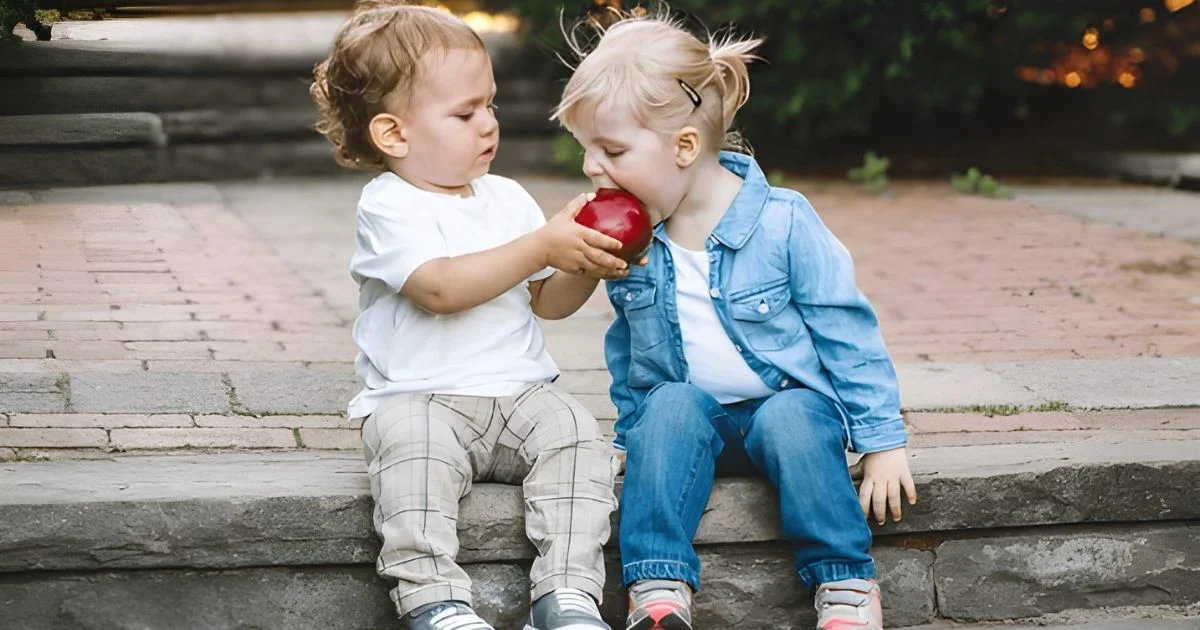
Over the past two decades, research has shown that even before a child can speak, understand rules, or internalize norms, they already display active empathy and spontaneous helping behaviors. A toddler reaches out to assist an adult in closing a door, hands back a dropped object, or comforts a crying peer. These actions—known as prosocial behaviors—arise naturally, without instruction, reward, or social pressure.
Tiny gestures like these, observed across cultures, tell the same story: that the social brain seems to respond instinctively to the distress of others. As if, before being moral, we were biologically connected. What once belonged to philosophy or poetry has now drawn the attention of scientists. But how can one prove that such a predisposition truly exists—that it’s independent of culture and education?
To find out, researchers sought to observe goodness in its purest form: during the earliest months of life—before language, before rules, before any notion of right or wrong. Several research teams have done exactly that, through a series of elegantly simple experiments—scenes where the hand of a child reveals more about what it means to be human than words ever could.
🔗 Read also: The tragic brain of Victor the wild child
The origins of empathy
Some images have the power to redefine what it means to be human. One of them is that of a baby handing a banana to an adult. A simple gesture that seems trivial—yet speaks volumes.
This scene unfolded in a laboratory at the University of Washington in Seattle, where psychologists Rodolfo Cortés Barragan and Andrew Meltzoff conducted a series of deceptively simple experiments. Their question was straightforward: Can a pre-verbal child perform a truly altruistic act?
The experiment looked like a game, and that’s what made it fascinating. An adult sat facing a child, holding a piece of fruit—a strawberry, a banana, or a grape—and then “accidentally” dropped it on their side of the table. The adult reached out, pretending to struggle to retrieve it, while the baby watched.
In nearly six out of ten cases, the infant crawled forward, picked up the fruit, and handed it back. A second experiment made the result even more striking: this time, the parents were asked to bring their children just before mealtime, when they were hungry. Even then, some of the toddlers chose to give the fruit away rather than eat it.
Their act went against a fundamental need—they gave up food they wanted simply because someone else seemed to need it more. Barragan and Meltzoff called this spontaneous altruism—a costly behavior performed without instruction, reward, or expectation of return.
Among chimpanzees tested under similar conditions, nothing of the sort occurred. They would help pick up an object, but never share desirable food. The contrast between ape and child reveals something deeply human: to give what one desires is to accept an immediate loss for another’s benefit.
At just nineteen months old, some babies were already capable of this—as if their brain knew, before they did, that the survival of our species depends on the outstretched hand.
🔗 Explore further: One day one story: Building brains through books
Inside the altruistic brain
What these experiments show so movingly, neuroscience now confirms: helping others is not just a choice—it’s a biological impulse. The baby’s act of handing back the banana is neither random nor learned. It’s rooted in a complex neural network known as the social brain—a system of regions that allow us to perceive, understand, and share the emotions of others.
When we see someone in distress, certain brain areas activate before we even have time to think. The insula, deep within the cortex, reacts to the sight of another’s suffering as if it were our own. The mirror neuron system, discovered in Parma in the 1990s, then comes into play—allowing us to “feel with” others, to mentally replicate their effort or pain. It’s this same mechanism that makes us flinch when someone gets burned, or reach out when someone trips.
Mirror neurons Discovered in the 1990s by Giacomo Rizzolatti and his team in Parma, mirror neurons revolutionized our understanding of the social brain. These nerve cells fire not only when we perform an action, but also when we observe someone else doing it—as if seeing were already doing.
In children, this system plays a key role in learning through imitation—walking, talking, smiling, understanding others’ intentions. It also underpins empathy: perceiving another’s pain, joy, or success activates the same brain circuits as if we were experiencing them ourselves. This mirror mechanism creates an automatic emotional resonance—a universal neural language that allows us to feel with before we can think about.
Higher up in the hierarchy, the ventromedial prefrontal cortex and anterior cingulate cortex orchestrate the response: they evaluate the situation, regulate the emotion, and transform raw empathy into concrete action. Together, these circuits form the brain’s true wiring of compassion—a network that turns the perception of suffering into the motivation to act.
🔗Explore further: How early experiences build our emotional and cognitive world
What morality calls goodness, the brain translates into a perfectly timed cascade of neural activations. But this machinery is inseparable from the body: every act of help triggers the release of oxytocin, the hormone of attachment and trust. Secreted during physical contact or emotional bonding, it strengthens feelings of closeness and mutual safety. Doing good, quite literally, feels good: the brain’s reward circuits, driven by dopamine, activate just as they do when we overcome a challenge or receive affection.
Anthropologists remind us that early human groups could survive only through cooperation—sharing food, protecting the weak, caring for the ill. Those who helped increased the survival of their group, and thus their genetic legacy.
That ancient circuitry still lives within us today. When we extend a hand to someone, we unknowingly replay a story hundreds of thousands of years old: the story of a social being wired for connection.
And while the world evolves, that reflex endures. Sometimes, all it takes is a look or a gesture to reactivate it—an ancient memory the brain has never forgotten.
Oxytocin Often called the hormone of attachment, oxytocin is a chemical messenger produced by the hypothalamus and released both in the brain and into the bloodstream. It shapes emotions, strengthens trust, and fosters cooperation. Present during breastfeeding, childbirth, and even simple physical contact, it reinforces social bonds, supports altruistic behaviors, and sharpens our ability to read emotions in others’ eyes. By creating a sense of closeness and belonging—to a group, a relationship, or a cause—it acts as the biological cement of human connection. In both infants and adults, it’s oxytocin that transforms interaction into attachment, and contact into trust.
🔗 Discover more: Contagious moods: How we feel what others feel
From instinct to intention: the education of empathy
If the human brain seems predisposed to benevolence, it still needs the right environment to express it. Like an instrument whose melody depends on how it’s played, the neural wiring of kindness requires a social context to unfold.
Developmental psychologists emphasize this point: helping and cooperation appear spontaneously in children, but their frequency and intensity depend on the emotional climate in which they grow. A trusting environment, parents attentive to others’ emotions, and daily models of solidarity all act as catalysts.
Studies by Sylvie Chokron and her team have shown that children raised in warm, empathetic environments detect others’ distress more quickly and respond more readily. Other research, notably by Lucie Rose and Klara Kovarski, confirms that children whose parents value cooperation and compassion develop helping behaviors earlier.
In other words, education doesn’t teach altruism—it sustains it. Kindness grows through experience. It’s not a naive impulse, but a relational skill that society can either cultivate or suppress.
Every time a child sees an adult lend a hand, share, or listen, their brain records a silent lesson: that cooperation is not weakness, but a form of vital intelligence. Each act of help, however small, reawakens this ancient memory within us—the memory of a world where to survive meant to care for one another.
The brain may be wired for goodness, but it’s up to every generation to keep the current alive—to preserve that fragile link connecting instinctive gesture to conscious choice, and thus to what makes us human.
References
Barragan RC, Brooks R, Meltzoff AN. Altruistic food sharing behavior by human infants after a hunger manipulation. Sci Rep. 2020 Feb 4;10(1):1785.
Benenson, J., Pascoe, J., & Radmore, N. (2007). Children’s altruistic behavior in the dictator game. Evolution and Human Behavior, 28, 168-175.
Rose, L., Kovarski, K., Caetta, F., Makowski, D., & Chokron, S. (2024). Beyond empathy: Cognitive capabilities increase or curb altruism in middle childhood. Journal of experimental child psychology, 239, 105810.
Zhou, X. (2024). The Formation Mechanism of Altruistic Behavior. Journal of Education, Humanities and Social Sciences.

Sara Lakehayli
PhD, Clinical Neuroscience & Mental Health
Associate member of the Laboratory for Nervous System Diseases, Neurosensory Disorders, and Disability, Faculty of Medicine and Pharmacy of Casablanca
Professor, Higher School of Psychology