Thriller: When fear becomes a show
In 1982, Michael Jackson was already a global icon, but he wanted to go further, to turn music into emotional cinema. As he began work on his sixth album, he asked producer Quincy Jones for one specific thing: “a song that scares people.”
Songwriter Rod Temperton, formerly of the band Heatwave, began sketching out a strange piece of music. Its first titles — Starlight, then Midnight Man — didn’t quite capture the feeling. Finally, he found the perfect word: Thriller — that shiver of fear and excitement that runs through the body like an electric charge.
Jackson’s idea wasn’t to tell a horror story, but to play with its codes. Fascinated by fantasy films, he wanted a track where terror could become shared pleasure. The result — produced with Quincy Jones’ meticulous precision — was a unique alchemy:
cold synthesizers, the sound of a beating heart, a quickened breath, and Jackson’s feline voice shifting from caress to cry. The lyrics, rhythmic and theatrical, unfolded like a movie scene.
When Pop became cinema
In 1983, Jackson transformed Thriller into a visual masterpiece. He called on director John Landis, who had just released An American Werewolf in London (1981), a film blending horror and humor. The resulting 14-minute short film would change pop culture forever. For the first time, a song became a narrative film.
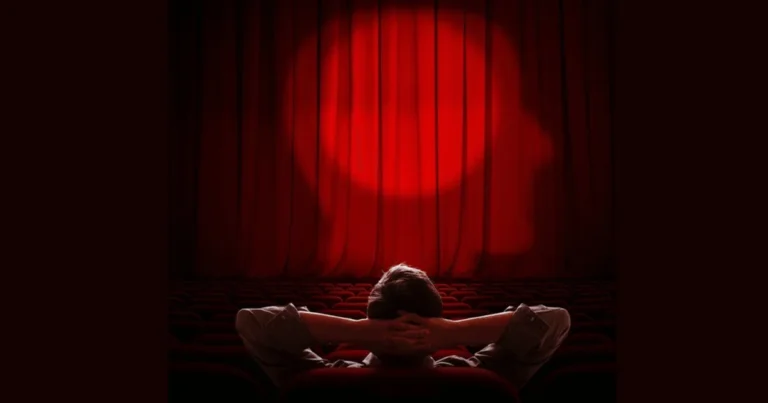
It had everything: the full moon, the scream, the metamorphosis, the dance of the dead. Jackson played a charming young man who, during a romantic date, suddenly turns into a werewolf. Later, in a cinema, he watches his own transformation — a playful game between fiction and reality, fear and delight.
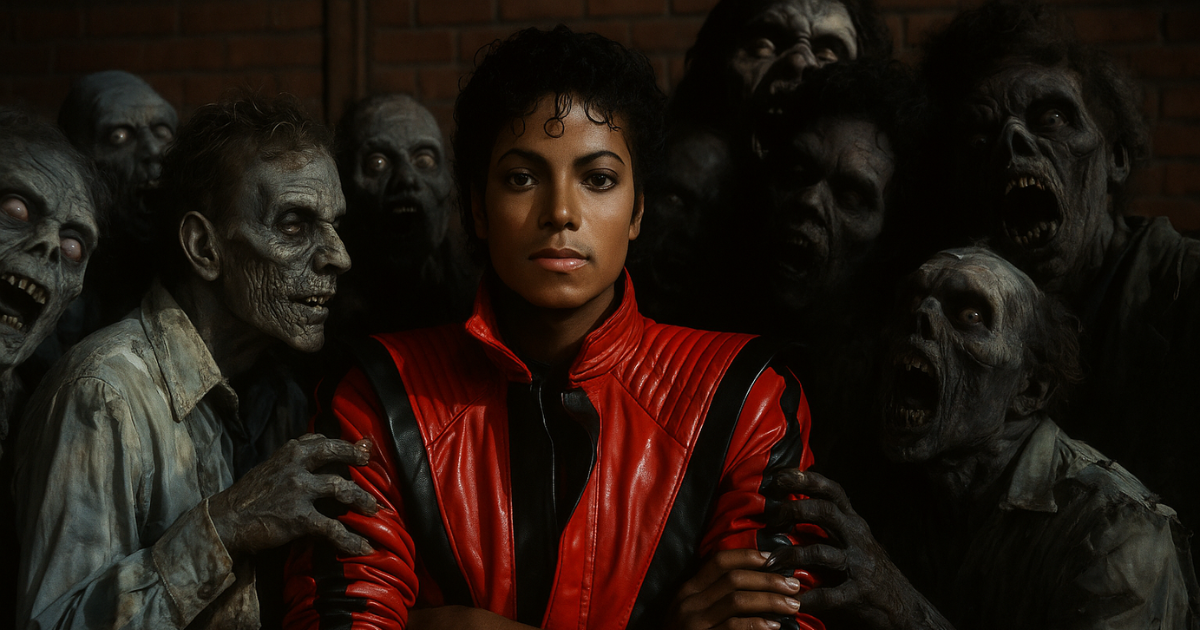
The zombie dance sequence, choreographed by Michael Peters, became legendary: an army of the undead, perfectly synchronized, moving to an irresistible funk beat. Horror became choreography. The shiver — an art of movement.
And to complete the atmosphere, Jackson invited Vincent Price, the iconic voice of gothic horror, to record the now-famous narration:
“Darkness falls across the land,
The midnight hour is close at hand…”
His cavernous tone and devilish laughter turned the song into a sonic ritual. But beyond spectacle, Thriller became a visual encyclopedia of horror’s most iconic symbols: the nocturnal forest, the full moon, the clawed hand, the crypt, the scream.
Still, Jackson’s goal wasn’t to terrify — it was to tame fear. Everything was choreographed, luminous, and controlled. Terror became a stage for vitality. In classic horror, fear represents chaos; in Thriller, it becomes structure — rhythm, gesture, repetition. The dead rise, not to attack, but to dance. Jackson transforms anxiety into collective play.
🔗 Read also: The thrill of fear : How the brain turns terror into pleasure
Thriller and the spirit of halloween
Although Thriller was never written for Halloween, it has become its unofficial anthem. Since the 1980s, the video has returned every October — replayed on MTV, reenacted in schools, parades, and flash mobs worldwide.
The zombie dance evolved into a global ritual each October 31st — a ceremony celebrating fear to master it. Thriller embodies the essence of Halloween: laughing at what frightens us, disguising death in joy, turning the macabre into movement.
Jackson understood that fear could be an art form — a choreographic energy that unites people. In his universe, terror is no longer a threat but a shared stage: a dance of the living facing the shadows.
Beneath this joyful surface, Thriller also reflects the social anxieties of 1980s America — an era marked by the Cold War, nuclear fear, the AIDS crisis, and urban disillusionment. Pop culture responded to these tensions by turning dread into performance: costume, parody, and spectacle became ways to domesticate fear.
In this context, Thriller acts as a mirror: fear becomes aesthetic rather than tragic. The monster is not rejected but celebrated. As a Black artist, Jackson reclaims a space long dominated by white horror cinema and transforms it into a symbol of power and cultural fusion. His zombies no longer represent chaos but unity through dance.
Vincent Price’s final laugh is no longer demonic — it’s the laughter of spectacle, a release that ends the ritual. Thriller doesn’t just entertain; it reveals a society learning to stage its own fears to survive them.
The brain that loves to be afraid
Why does Thriller bring such intense pleasure?
Because the human brain doesn’t fully distinguish between fear and excitement. Both activate the same neural circuits: the amygdala (alert, anticipation of danger), the hypothalamus (release of adrenaline), and the dopaminergic system, which produces reward and pleasure.
When fear occurs in a safe context — in film, music, or games — it becomes emotionally stimulating. The heartbeat accelerates, but no real danger exists. The brain translates that tension into a pleasurable thrill.
That’s the secret of the chorus — “’Cause this is thriller, thriller night.” The tension builds, but the beat invites us to dance. We crave fear, but even more, we crave to share it. Fear becomes a social emotion, a shared pulse.
🔗 Explore further: Halloween: Decoding fear
Controlled fear whether through film, music, or celebration — triggers dopamine, the same molecule linked to laughter and success. Thriller succeeds where many horror films fail: it makes the brain dance along its fear circuits.
Legacy and immortality of the myth
Thriller marked a turning point in the history of both music and image. It was the first music video broadcast as a global event, the first to enter the U.S. National Film Registry (2009), and the first to make fear a universal pop language.
Since its release, Thriller has shaped our collective imagination — from Scream to The Weeknd, and even to the precisely choreographed world of K-pop. Every October 31st, millions of bodies repeat the same moves — a modern ritual turning death into rhythm, fear into communion.
Thriller is not just a song or a video; it’s a sensorial myth. Michael Jackson understood before anyone else that art could transmute terror into pleasure, anxiety into energy, death into dance.
By merging music, cinema, and psychology, he invented the first joyful fear myth — a space where we can tremble without danger, scream in rhythm, and emerge alive. And with every drumbeat and every echo of Vincent Price’s laugh, the world remembers:
we can be afraid together — and survive it.
References
Landis, J. (Director). (1983). Michael Jackson’s Thriller [Short film]. Optimum Productions. https://www.youtube.com/watch?v=sOnqjkJTMaA (YouTube)
Library of Congress. (2009, December 29). Michael Jackson, the Muppets and Early Cinema Tapped for 2009 National Film Registry (Press release). https://www.loc.gov/item/prn-09-250/ (The Library of Congress)
Griffin, N. (2010, June 24). The “Thriller” Diaries. Vanity Fair. https://www.vanityfair.com/culture/2010/07/michael-jackson-thriller-201007 (Vanity Fair)
Hebblethwaite, P. (2013, November 21). How Michael Jackson’s Thriller changed music videos for ever. The Guardian. https://www.theguardian.com/music/2013/nov/21/michael-jackson-thriller-changed-music-videos (The Guardian)

Amine Lahhab
Television Director
Master’s Degree in Directing, École Supérieure de l’Audiovisuel (ESAV), University of Toulouse
Bachelor’s Degree in History, Hassan II University, Casablanca
DEUG in Philosophy, Hassan II University, Casablanca