The new era of intelligent neurorehabilitation
Every year, more than sixteen million people around the world experience a stroke. For almost one third of them, the consequences are lasting: paralysis, language impairments, memory difficulties, or depression. Although traditional rehabilitation such as physiotherapy, occupational therapy, and speech therapy provides meaningful improvement, its effects quickly reach a ceiling. These approaches rely on repeating movements or exercises without always being able to efficiently engage the damaged neural circuits.
This is where a new generation of therapeutic tools is attracting growing attention: brain computer interfaces, or BCI. These systems decode the brain’s electrical signals in real time and translate them into commands capable of activating a robot, an electrical stimulation, or a virtual environment. Their purpose is to provide the brain with direct feedback on its own neuronal activity, helping it correct dysfunctional patterns and strengthen the connections that support recovery. Recent research confirms that these technologies no longer belong to science fiction. They now represent a promising frontier in neurological rehabilitation, influencing the body, cognition, and emotions simultaneously.
Turning thought into action for motor recovery
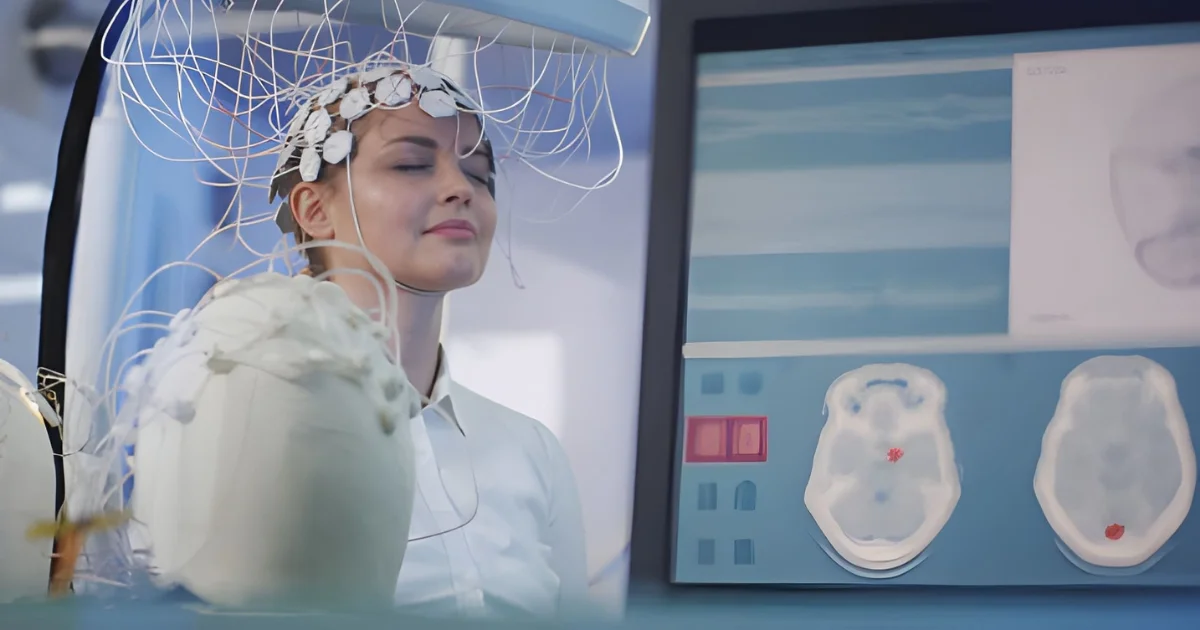
The historic core of BCI research is motor rehabilitation. After a stroke, half of all patients retain motor impairments, often caused by disrupted communication between the motor cortex and the muscles. Brain computer interfaces aim to reactivate these pathways. By recording electrical signals from the motor cortex through electroencephalography or electrocorticography, they transform the intention to move into action: a robotic arm rises, a virtual hand closes, or electrical stimulation contracts a paralyzed muscle.
This closed loop of intention, feedback, and action promotes cerebral plasticity. Neurons that fire together reconnect according to Hebb’s principle. A recent study published in BioScience Trends reported several protocols of this kind. After twelve sessions of BCI combined with functional electrical stimulation, patients with chronic hemiplegia improved their motor score by more than four points on the Fugl Meyer scale, a major benchmark in post stroke rehabilitation.
Hebb’s Principle: Formulated in 1949 by Canadian neuropsychologist Donald Hebb, this principle describes a fundamental mechanism of neural learning. When neuron A repeatedly activates neuron B, the synaptic connection between them becomes stronger. This process, called synaptic plasticity, underpins cerebral adaptation. In post stroke rehabilitation, it explains how the repetition of imagined or BCI assisted movement can reactivate dormant neural circuits and restore motor function. By reestablishing the association between intention and execution, the brain quite literally relearns how to reconnect.
The benefits are not limited to the arm or hand. Systems combining a leg exoskeleton with an EEG VR interface now make gait retraining possible. Brain signals linked to imagined movement trigger robotic propulsion, creating a realistic motor illusion that stimulates corticospinal circuits. In some trials, stability and step coordination improved within only a few weeks, confirming the brain’s capacity to reprogram itself when provided with coherent sensory feedback.
Technology continues to progress. New generations of BCI use artificial intelligence to adapt the difficulty of exercises in real time. When patients improve, algorithms increase task complexity or modify the type of feedback such as visual, auditory, or tactile. This personalized approach enhances engagement while reducing cognitive fatigue, a key factor for long term success.
🔗 Read also: Mindwriting: Giving voice to thought through neural interfaces
Neurotechnology reaches higher cognitive functions
After focusing for decades on movement, BCI supported rehabilitation is expanding toward memory, attention, language, and emotional regulation. A stroke does not only affect the body. It also disrupts cognitive and affective circuits. According to studies compiled in Frontiers in Human Neuroscience, more than half of stroke survivors experience cognitive impairment and almost one third suffer from depression or anxiety.
Brain computer interfaces offer a form of cognitive neurofeedback. By visualizing their own brain waves in real time, patients learn to regulate areas involved in concentration or memory. Alpha and theta oscillations serve as reference markers whose modulation strengthens attention or recall. Some protocols involve immersive virtual reality environments such as object race simulations or spatial navigation tasks in which performance depends on stabilizing cerebral rhythms. These training sessions reproduce real life situations while maintaining high levels of engagement.
Neurofeedback: Neurofeedback consists in presenting an individual with real time measurements of their brain activity. Through electroencephalography, patients observe their own brain waves and learn to modulate them voluntarily. In post stroke rehabilitation, this immediate feedback acts as a self training mechanism. Seeing the motor region activate during imagined movement reinforces confidence, motivation, and the link between intention and action. This closed loop mechanism is central to BCI, where the brain becomes both the emitter and the regulator of its own signal.
BCI also shows strong potential for language rehabilitation. By capturing activity changes in frontal and temporal regions such as Broca’s and Wernicke’s areas, neurofeedback systems help patients with aphasia improve verbal fluency and comprehension. In some pilot studies, only ten sessions targeting the balance between beta and theta waves were enough to increase speech rate and lexical accuracy.
Nevertheless, a careful analysis of all clinical trials conducted so far highlights several limitations. The effects are real but often temporary, and their magnitude varies depending on patient motivation, lesion location, and signal quality. Technical challenges also remain significant. EEG signals are sensitive to interference and require regular calibration, while current headsets and electrodes remain bulky, restricting most BCI use to hospital settings.
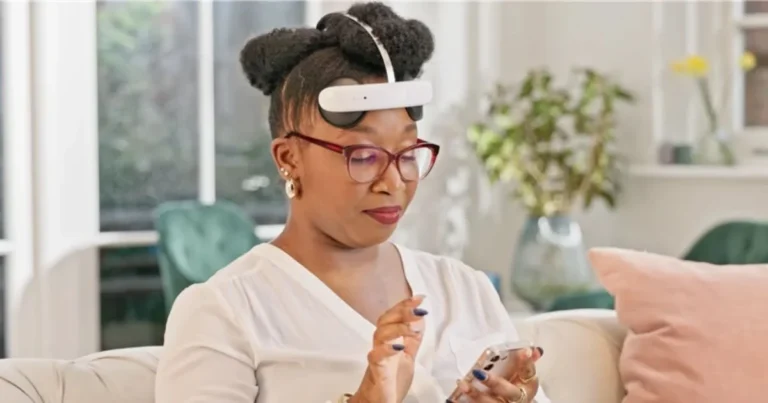
Even with these constraints, technological advances follow an encouraging trajectory. Device miniaturization, wireless systems, and the growing integration of artificial intelligence suggest much more flexible applications in the near future. Researchers envision portable home based interfaces capable of supporting daily training under remote medical supervision.
🔗 Explore further: When AI thinks like a brain
The combination of virtual reality and artificial intelligence already makes these tools more immersive and personalized. Systems learn to recognize each patient’s neurocognitive profile, including progression rate, fatigue, and emotional state, to adapt exercises and sensory feedback in real time. This intelligent self training transforms BCI into a hybrid form of rehabilitation that is simultaneously technological, behavioral, and psychological.
Experts predict that over the next decade, these interfaces could gradually become part of standard rehabilitation protocols alongside physiotherapy or transcranial magnetic stimulation, paving the way for fully connected and individualized neurorehabilitation.
References
Liu, J., Li, Y., Zhao, D., Zhong, L., Wang, Y., Hao, M., & , J. (2025). Efficacy and safety of brain–computer interface for stroke rehabilitation: an overview of systematic review. Frontiers in Human Neuroscience, 19.
Ya-nan Ma, Kenji Karako, Peipei Song, Xiqi Hu, Ying Xia (2025). Integrative neurorehabilitation using brain-computer interface: From motor function to mental health after stroke. Bioscience trends.