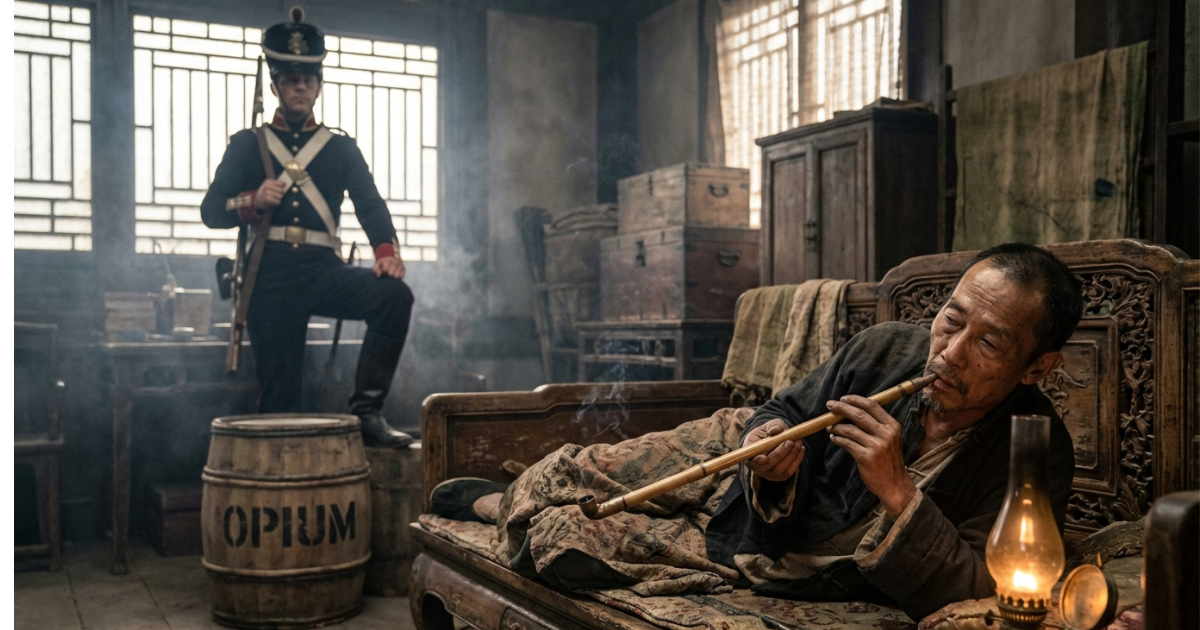
The opium war: The empire that fell asleep
In the 19th century, opium was more than a commodity, it was a weapon.
By embedding addiction within an empire, it turned a global power into a vulnerable society, exposing the links between dependency and domination.
The story of opium does not begin in the smoky dens of Canton but far earlier, in the fertile valleys of the ancient Fertile Crescent, where the Sumerians cultivated the opium poppy more than 5,000 years ago. Known as the “plant of joy,” it served medicinal purposes among Egyptians, Persians and Greeks. Over the centuries, its hypnotic resin traveled with merchant caravans, moved across India, reached Persia and ultimately entered China.
In imperial China, opium was originally a remedy. Physicians of the Tang dynasty used it to ease pain and soothe coughs. However, by the eighteenth century, its recreational use surged, encouraged by expanding trade with British merchants. Indian-grown opium became a currency exchanged for Chinese tea, a trade so profitable that it would soon reshape global power balances.
During that same era, China stood as the world’s foremost economic power, self-sufficient and largely closed to European goods. The British, desperate for Chinese tea and silk, spent enormous amounts of silver, creating a trade deficit that threatened their economic stability. To counter this imbalance, the British East India Company devised a cynical strategy: sell opium cultivated in Bengal to China and buy tea with the resulting profits. The poppy thus transformed from a simple crop into an economic weapon and later a political one.
🔗Explore further: The body as the first witness of addiction
The first war for the mind
In Canton in 1839, China confronted one of Britain’s quietest tools of domination: opium. This was not a territorial conflict but a battle of minds, where pleasure became a strategic instrument.
Under a humid sky, Chinese soldiers dumped crates of opium into the sea. The bitter scent of the resin drifted above the waves and evaporated into the heavy air. Leading this unprecedented operation was Lin Zexu, a devoted official of Emperor Daoguang, who embodied the resistance of an empire forced to its knees.
Before reaching this point, Lin Zexu had tried everything. In a solemn letter addressed to Queen Victoria, he asked: “How can you prohibit opium within your own kingdom, yet force it upon other nations?” His appeal to moral responsibility went unanswered. He then acted. Lin Zexu ordered the confiscation and destruction of 20,000 chests of opium belonging to British merchants. This bold gesture, moral and political at once, ignited the First Opium War (1839–1842).
China was not fighting on equal terms. British ships cut through the South China Sea with the mechanical precision of the modern industrial age. Their steam-powered cannons crushed imperial junks, and their diplomats imposed their will.
In the name of “free trade,” London defended a commerce whose destructive consequences it fully understood. Behind the banners of the British Empire lay an unsettling truth: opium had become a diplomatic weapon. It was no longer a mere commodity but a tool of subjugation, a war fought through pleasure and dependence. By weakening the people, one weakened the state. By maintaining addiction, one ensured compliance.
🔗 Read also: Can psychedelics heal the mind?
The West did not need to conquer China by force. It only needed to keep China dependent. China’s defeat was devastating. The Treaty of Nanking forced the opening of ports, the cession of Hong Kong and the payment of immense reparations. The poppy had subdued the empire. When the Second Opium War erupted (1856–1860), tragedy turned into humiliation. The Summer Palace in Beijing was looted, and Western powers paraded through the Forbidden City as if strolling through a conquered museum. This was not merely a military loss but a psychological rupture.
A nation in the grip of dependence
Nineteenth century China was no longer the land of Tang poets or Confucian scholars. In the ports of Canton, Shanghai and Tianjin, opium dens spread like temples of sleep. Wealthy scholars in silk robes and exhausted peasants sat side by side in the same sweetened haze, motionless and detached from time. Bodies weakened and minds drifted. Dependence became a collective ritual.
Some provinces reported that one man in ten smoked opium daily. In the bureaucracy, officials were so addicted they sometimes forgot to seal imperial decrees. An entire people slipped gradually into torpor, not out of cowardice but because it had lost control over its own system of reward.
This social anesthesia served foreign powers well. Unequal treaties multiplied, ports opened and wealth flowed outward. Addiction became the Trojan horse of colonial expansion. What the West celebrated as “free trade,” China experienced as an intimate dispossession: of the body, of dignity and of consciousness.
In the works of Lu Xun and Lao She, opium became a metaphor for a sleeping nation, one that only a radical awakening could revive. This early “war for the brain” was not solely economic but deeply psychological.
Lu Xun: Awakening a Sleeping Nation “Save souls before saving the nation.”
Considered the father of modern Chinese literature, Lu Xun (1881–1936) transformed opium into a symbol of national paralysis. In his writings, addiction was not an individual failing but the expression of a society numbed by resignation. His seminal work, A Madman’s Diary (Kuangren riji, 1918), condemned a culture stifled by conformity and passivity. Through satire and sharp insight, Lu Xun called for a moral and intellectual awakening: leaving the opium den meant reclaiming one’s ability to think independently. His poetic yet political prose fueled the May Fourth Movement of 1919, which placed culture and consciousness at the center of China’s renewal. Lu Xun did not fight with weapons but with words: the kind that awaken.
The dragon’s revenge
A century later, China has risen again, and the memory of opium still burns like a national scar. In the streets of Beijing or Chengdu, public health posters repeat the warning: “Drugs destroy the nation before they destroy the individual.”
This is no metaphor. Since the 1980s, the People’s Republic of China has enacted some of the world’s strictest anti drug laws. Producing, selling or transporting significant amounts of narcotics — 50 grams of heroin or one kilogram of opium — can lead to the death penalty.
The annual campaigns of June 26, National Anti Drug Day, are striking. There are parades, educational videos and sometimes even publicized executions. The objective is clear: erase any trace of the century of humiliation.
However, this severity is more than a legal tool. It has become a cultural reflex, almost a neural one. Chinese society has internalized addiction as a symbol of losing control, both individually and collectively. The state does not simply fight drugs. It combats the possibility of psychological weakness on a national scale.
According to the World Drug Report 2024 (UN), drug use in China remains under 0.3% of the adult population, compared with over 8% in the United States and 4% in Europe. This difference stems not only from repression but also from memory. Drugs still evoke colonization, submission and humiliation.
In China, using drugs is not merely breaking the law. It is betraying history. Thus the empire once subjugated through addiction has built its revival on its opposite: absolute control.
Reconstruction after ruin
Modern China has rebuilt itself on the ruins of a deep trauma: a people stripped of will, numbed by dependence and vulnerable to foreign powers. The “century of humiliation,” from the First Opium War (1839) to the founding of the People’s Republic (1949), remains the heartbeat of the national narrative. In museums and textbooks, it is not presented as a simple political defeat but as an existential warning: where dependence settles, mastery disappears.
From this wound emerged a philosophy of discipline and control. Where opium paralyzed bodies, labor reawakened them. Where torpor consumed the spirit, productivity became a collective virtue. Within a century, China moved from the opium den to the factory floor, from dependence to efficiency. A people once subdued by pleasure built its strength on rigor and self mastery.
🔗 Explore further: Requiem for a dream: Unraveling the psyche’s dark corners
Today, this energy of reconstruction permeates every sphere of the country: industry, education, scientific research. The very notion of individual weakness is perceived as a threat to national cohesion. Work is not merely an economic value but an act of rehabilitation, proof that a body can reclaim its function, its strength and its purpose. The memory of opium has not vanished. It has transformed. What was once poison has become fuel.
Memory of Trauma: When History Leaves Traces in the Brain
Neuroscience has shown that individual trauma can leave a lasting imprint on our emotional memory. The amygdala, the brain’s vigilant sentinel, records moments of danger, while the hippocampus stores their narrative context. When an entire group is shaken by a traumatic event, its effects can also ripple across generations—not as a clear, inherited memory, but as patterns of vigilance, learned behaviors, and family or social dynamics. Over time, this can manifest as heightened alertness, a need for control, or a persistent fear of loss.
Contemporary China offers a striking illustration of this phenomenon—not in the sense of a biologically transmitted memory, but as a cultural and historical imprint shaped by collective wounds. The nation’s strict “zero-tolerance” drug policies, for instance, can be seen as a collective response rooted in the painful history of addiction and national humiliation in the nineteenth century. What a single neuron attempts to heal within an injured brain, an entire civilization may strive to mend at the scale of a people—through laws, shared stories, and a determined effort to avoid reliving the irreparable.
The history of opium is not confined to the past. It resonates today in a world saturated with new forms of dependence, no longer only chemical but digital, consumerist and emotional. Every society has its opium: entertainment, speed, performance or the promise of instant well being.
By designating drugs as a primary enemy, China sought to exorcize an ancient weakness that once undermined its empire. This stance, shaped by the memory of catastrophe, offers a silent lesson to a world now captive to subtler addictions disguised as progress. From the smoke of the poppy to the luminous pixel of our screens, one question endures:
How far are we willing to trade our freedom for the illusion of pleasure?
References
Centers for Disease Control and Prevention (CDC). (n.d.). Provisional Drug Overdose Deaths (NVSS).
Congressional Research Service. (2024). China Primer: Illicit Fentanyl and China’s Role.
Lin, Z. (1839/2011). Letter to Queen Victoria (1839). Bloomsbury Academic
Lovell, J. (2011). The Opium War: Drugs, Dreams and the Making of China. Picador.
United Nations Office on Drugs and Crime (UNODC), Laboratory and Scientific Service. (2019). Announcement to place all fentanyl-related substances under national control (China).
United Nations Office on Drugs and Crime (UNODC). (2024). World Drug Report 2024.

Amine Lahhab
Television Director
Master’s Degree in Directing, École Supérieure de l’Audiovisuel (ESAV), University of Toulouse
Bachelor’s Degree in History, Hassan II University, Casablanca
DEUG in Philosophy, Hassan II University, Casablanca